
How to interpret engineering calculations for Texas projects

Staring at a structural report full of symbols, formulas, and technical jargon can feel overwhelming for Texas homeowners and contractors. Engineering calculations determine whether your project meets safety codes and structural integrity standards, yet many struggle to decode these essential documents. This guide breaks down the key components of engineering calculations step by step, empowering you to read plans confidently, verify compliance with Texas requirements, and communicate effectively with engineers. You’ll learn to identify critical information, interpret load formulas, spot common errors, and know when to seek professional guidance for your construction project.
Table of Contents
- Key takeaways
- Understand the components of engineering calculations and plans
- Interpret load calculations and mechanical formulas
- Step-by-step guide to verifying engineering calculations for your project
- Common mistakes and troubleshooting when interpreting calculations
- Enhance your project with expert engineering inspections and reports
- FAQ
Key Takeaways
| Point | Details |
|---|---|
| Plan components | Engineering calculations are organized by title blocks, notes, schedules, symbols, and grid lines to guide interpretation. |
| Engineer stamp | Verify that the engineer stamp is current and matches the project scope as a legal requirement. |
| General notes | General notes describe assumptions, material specifications, and the code edition applied to the calculations. |
| Schedules and symbols | Schedules and symbols explain quantities, locations, and rebar specifications and the shorthand used on drawings. |
| Load considerations | Dead and live loads are considered in the calculations to assess safety and code compliance. |
Understand the components of engineering calculations and plans
Engineering calculations in Texas construction are presented in structural reports, plans, and drawings, focusing on load assessments, performance metrics, and compliance with codes like ASCE guidelines. These documents form the technical foundation for safe, legal construction. Before interpreting numerical formulas, you need to recognize the standard elements that organize this information.
The title block sits prominently on each sheet, providing the scale, revision date, project identifier, and the engineer’s official stamp. This stamp confirms a licensed professional engineer reviewed and approved the calculations, a legal requirement under Texas engineer licensing rules. Always verify the stamp is current and matches the project scope.
General notes explain the assumptions behind calculations, material specifications, and code references. These notes might state soil bearing capacity, concrete strength (e.g., 3000 psi), or lumber grade (No. 2 Southern Pine). They also clarify which edition of building codes applies, typically the International Building Code as adopted by Texas jurisdictions. Reading these notes first prevents misinterpreting calculations based on different assumptions.
Schedules list quantities and types of structural elements. A footing schedule might show dimensions like 24"x24"x12" with 4#5 rebar, while a beam schedule could specify W10x22 steel beams at 16 feet on center. The notation 4#5@12" O.C. means four number 5 rebar bars spaced 12 inches on center. Recognizing this shorthand helps you cross-reference drawings with material orders.
Symbols and legends decode abbreviations throughout the plans. Common symbols include triangles for column locations, circles with numbers for detail callouts, and arrows indicating section cuts. The legend translates these visual markers into actionable information. Grid lines, labeled with letters and numbers, help you locate features and cross-reference details across multiple sheets.
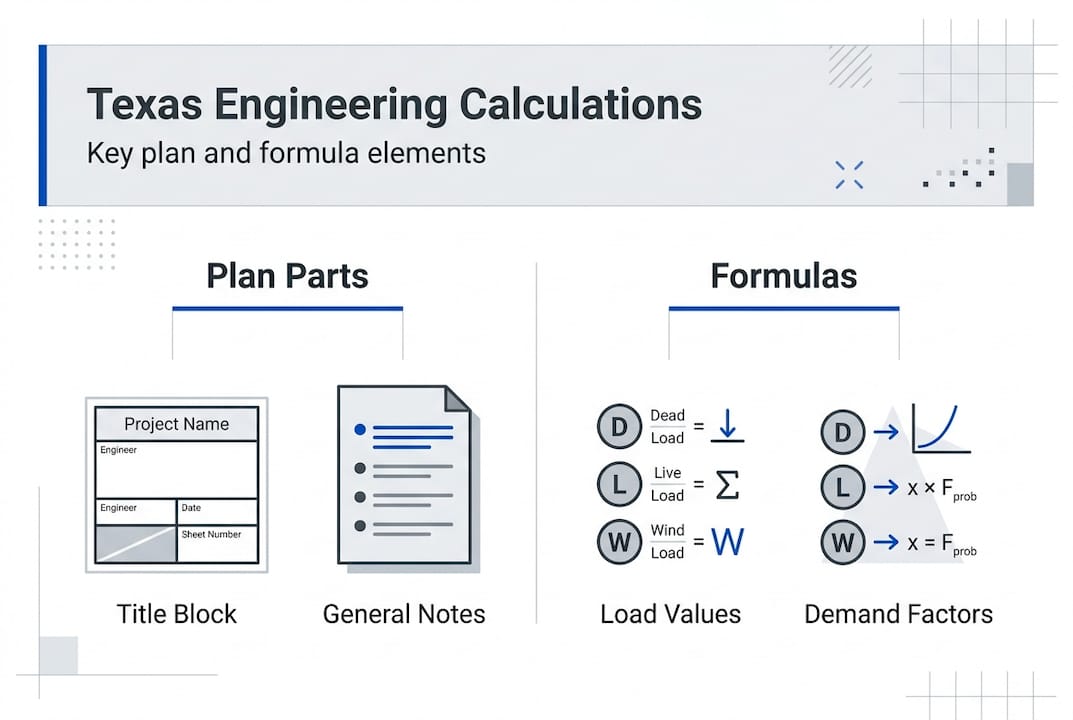
Mastering these plan components creates a solid foundation for interpreting the actual engineering calculations that follow. Key elements to identify include:
- Title block with engineer stamp, date, and revision number
- General notes covering assumptions, materials, and code compliance
- Schedules detailing beams, footings, columns, and rebar specifications
- Symbol legends explaining abbreviations and graphical markers
- Grid lines for locating and cross-referencing structural elements
For Texas projects, understanding construction plans and their purpose ensures you can navigate both the visual and numerical aspects of engineering documentation effectively.
Interpret load calculations and mechanical formulas
With plan components understood, you can now focus on the engineering calculations themselves. Texas construction involves multiple load types that engineers must account for to ensure structural safety. Dead loads represent permanent weight like the structure itself, roofing, and fixed equipment. Live loads cover temporary forces such as occupants, furniture, and snow (minimal in most Texas regions but still considered). Wind loads matter significantly in coastal areas prone to hurricanes, while seismic forces apply in limited West Texas zones.
Deflection limits like L/360 indicate maximum allowed bending to prevent damage or discomfort. The formula δ = 5wL⁴/384EI calculates beam deflection, where w is the distributed load, L is span length, E is the modulus of elasticity, and I is the moment of inertia. A 20-foot floor beam supporting 50 pounds per linear foot with E = 1,600,000 psi and I = 200 in⁴ would deflect approximately 0.67 inches. Dividing span by deflection (240/0.67 = 358) shows this meets the L/360 requirement.
Electrical load demand factors reduce calculated loads realistically in design. The National Electrical Code applies 100% of the first 10 kVA and 40% above that threshold for dwelling units. A home with 15 kVA calculated load would use 10 + (5 x 0.40) = 12 kVA for service sizing. This prevents oversizing panels and wiring, cutting material costs substantially.
HVAC load calculations consider sensible heat (temperature change) and latent heat (humidity), both significant in humid Texas climates. Manual J calculations factor in insulation R-values, window areas, orientation, and occupancy. A 2,000-square-foot home in Houston might require 3 tons of cooling, while the same home in El Paso needs only 2.5 tons due to lower humidity. Using actual calculations instead of rules of thumb prevents oversizing that wastes energy and money.
Pro Tip: Cross-check load values in reports against known local benchmarks to spot oversizing or errors. If a modest residential addition shows electrical demand exceeding commercial standards, question the calculations.
Common calculation elements you’ll encounter:
- Dead loads: structural weight, finishes, permanent equipment
- Live loads: occupants, furniture, movable items
- Wind loads: based on Texas wind speed maps and exposure categories
- Deflection formulas: beam bending calculations ensuring serviceability
- Demand factors: realistic load reductions for electrical and mechanical systems
| Load Type | Texas Benchmark | Formula/Factor |
|---|---|---|
| Floor live load | 40 psf residential | Per IBC Table 1607.1 |
| Wind speed | 115-150 mph coastal | ASCE 7 wind maps |
| Electrical demand | 100% first 10kVA, 40% above | NEC Article 220 |
| Deflection limit | L/360 floors, L/240 roofs | δ = 5wL⁴/384EI |
Understanding engineering calculations for Texas homes and following a structural engineering guide helps you verify these formulas apply correctly to your specific project conditions.
Step-by-step guide to verifying engineering calculations for your project
After learning about calculations, move into a structured verification process. Following these steps ensures you catch errors early and maintain project safety. Start with title block details including scale, revisions, and the engineer stamp, then read general notes, schedules, symbols, grid lines, and detailed plans and elevations.
-
Check the engineer’s stamp and license number against the Texas Board of Professional Engineers database to confirm active status and proper credentials.
-
Review the title block for the latest revision date, ensuring you’re working from current, approved documents rather than outdated drafts.
-
Read general notes carefully to understand soil assumptions, material grades, code editions, and any project-specific conditions that affect calculations.
-
Cross-reference beam schedules with plan drawings, verifying sizes and locations match. A W12x26 beam shown in the schedule must appear at the correct grid location on the framing plan.
-
Compare footing schedules with foundation plans, checking dimensions and rebar quantities. A schedule calling for 6#6 bars should show six number 6 rebars in the corresponding detail drawing.
-
Use the deflection formula and load benchmarks to spot-check critical members. Calculate expected deflection for the longest span beam and verify it meets L/360 or L/240 limits.
-
Verify ASCE 2022 compliance is explicitly stated in notes or title block, as Texas licensing law requires current code adherence.
-
Commission a professional engineer review if calculations seem incomplete, use unfamiliar methods, or involve complex structural systems like post-tensioned slabs or moment frames.
Pro Tip: Avoid reports that lack explicit calculations or rely on vague statements like “adequately sized per experience.” These shortcuts can lead to oversizing, undersizing, or permit rejection.
| Report Type | Pros | Cons |
|---|---|---|
| Detailed calculation-backed | Meets ASCE requirements, defensible, accurate sizing, smooth permitting | Higher upfront cost, requires technical review |
| Visual-only summary | Quick to produce, lower initial cost | Lacks math verification, risks oversizing, may fail permit review, liability concerns |
Understanding how to read engineering reports and recognizing why licensed engineers matter helps you demand appropriate documentation quality for your Texas construction project.
Common mistakes and troubleshooting when interpreting calculations
Conclude the instructional content by addressing frequent errors. Many homeowners and contractors misread rebar notation, confusing 4#5@12" O.C. (four number 5 bars at 12-inch spacing) with four 5-inch bars. This misunderstanding can lead to incorrect material orders or construction errors. Always clarify unfamiliar symbols with the engineer before proceeding.
Ignoring electrical demand factors causes significant oversizing. Calculating total connected load without applying NEC demand factors can inflate service requirements by 50% or more, wasting money on oversized panels and wiring. Rules-of-thumb versus calculated methods show that precise calculations save 25-50% in material costs compared to conservative estimates.
Assuming bigger is always safer leads to unnecessary expenses. Oversizing HVAC systems reduces efficiency, causes short cycling, and fails to control humidity properly in Texas climates. An oversized 4-ton unit when 3 tons suffices wastes $1,500-$2,500 in equipment costs plus ongoing energy penalties.
Foundation calculations require special attention in Texas due to expansive clay soils. Foundation movement from clay soils and plumbing leaks demands moisture management strategies like proper grading and foundation watering systems. Verify soil reports accompany foundation calculations, especially for pier and beam or post-tensioned slab designs.
Simplified reports lacking detailed math create legal and safety risks. Texas engineering law requires calculations demonstrate compliance, not just visual inspections or experience-based sizing. Vague reports can jeopardize safety and code compliance, exposing you to liability if structural failures occur.
Indeterminate structural frames, continuous beams, or complex load paths need advanced analysis software. Hand calculations work for simple span beams but fall short for multi-story buildings or irregular geometries. Recognize when projects exceed simple calculation methods and demand computer-verified analysis.
Pro Tip: Always demand engineer seals and full calculation details for legal and safety assurance. A sealed report provides professional liability protection and satisfies building department requirements.
Frequent errors to avoid:
- Misreading symbols and rebar notation on schedules
- Skipping demand factor reductions in electrical and HVAC sizing
- Assuming oversizing improves safety without considering performance penalties
- Ignoring soil reports for foundation design in expansive clay regions
- Accepting simplified reports without explicit calculations
- Attempting to verify complex structures without professional software analysis
Comparing top engineering services in Texas and understanding licensed engineer benefits helps you select qualified professionals who provide complete, accurate calculation documentation.
Enhance your project with expert engineering inspections and reports
Now that you understand how to interpret engineering calculations, consider how professional engineering services streamline your Texas construction project. Texas Licensed Engineers deliver comprehensive structural inspections and detailed reports specifically tailored for residential and commercial projects across Houston, Austin, Dallas, San Antonio, and beyond. Their expertise translates complex technical documents into practical guidance you can apply confidently at your job site.

Following a thorough structural inspection checklist ensures every aspect of your project meets local codes and safety standards. Professional engineers verify calculations, review construction plans, and provide sealed documentation that satisfies building departments. This service minimizes permit delays, prevents costly rework, and protects your investment through proper structural design.
Whether you need foundation inspections for expansive clay soils, load calculations for additions, or forensic investigations after damage events, engineering inspections and reports bridge the gap between technical requirements and successful project execution. Partnering with licensed professionals gives you confidence that your construction meets the highest standards of safety and compliance.
FAQ
What should I look for in an engineering calculation report?
Check for the engineer’s stamp with license number and date, explicit calculations showing formulas and load paths, compliance notes referencing ASCE and Texas codes, and detailed material specifications. Verify calculations align with your project’s actual conditions, including soil type, building dimensions, and intended use. Reports lacking these elements may not satisfy building departments or provide adequate structural verification.
Understanding how to read engineering reports helps you identify complete documentation versus incomplete summaries.
How do load demand factors affect my project’s calculations?
Demand factors reduce conservative load totals to practical levels, optimizing material use and cutting costs significantly. For electrical systems, the NEC applies 100% of the first 10 kVA and 40% above that threshold, preventing oversized service panels. HVAC calculations use diversity factors recognizing that not all equipment operates simultaneously. Applying these factors correctly can reduce material costs by 25-50% compared to simple addition of all loads.
Exploring engineering calculations for Texas homes shows how demand factors apply across different systems.
When should I consult a professional engineer for interpretation help?
Consult a licensed PE when reports lack detailed calculations, contain ambiguous technical terms, or involve complex structural elements like moment frames or post-tensioned slabs. Seek professional help for projects on expansive clay soils, in high wind coastal zones, or when building departments question your documentation. Any time you’re uncertain about calculation validity or safety implications, professional review protects your investment and ensures code compliance.
Learning why licensed engineers matter in Texas clarifies when professional expertise becomes essential.
What are the most common symbols in structural engineering plans?
Common symbols include circles with numbers indicating detail callouts, triangles marking column grid intersections, arrows showing section cut locations, and dashed lines representing hidden or future elements. Rebar notation like 4#5@12" O.C. means four number 5 bars spaced 12 inches on center. Beam designations such as W12x26 specify wide flange steel beams 12 inches deep weighing 26 pounds per foot. Always reference the legend on each sheet to decode project-specific symbols.
How do I verify soil conditions match foundation calculations?
Request the geotechnical report that accompanies foundation calculations and confirm the soil bearing capacity, moisture content, and clay composition match the engineer’s assumptions. Texas expansive clay soils require special attention to seasonal moisture changes. The report should specify bearing pressure in pounds per square foot and recommend foundation type (slab on grade, pier and beam, or post-tensioned). If site conditions changed after the soil report, notify your engineer immediately for recalculation.
Recommended
- How to Read Engineering Reports for Texas Projects – Texas Licensed Engineers
- How to Select Engineering Services for Texas Projects – Texas Licensed Engineers
- 7 Types of Engineering Calculations for Texas Homes – Texas Licensed Engineers
- Structural Engineering Guide 2025 for Texas Projects – Texas Licensed Engineers


