
Master the floor plan design process for Texas projects

Homeowners and contractors in Texas often face costly delays and budget overruns because they misunderstand the floor plan design process. Whether you’re planning a custom home in Houston or a commercial space in Austin, navigating site-specific challenges like expansive clay soils, floodplain regulations, and complex permitting requirements demands clarity. This guide walks you through every phase of residential and commercial floor plan design in Texas, helping you avoid expensive mistakes, streamline approvals, and deliver projects that meet code and client expectations from day one.
Table of Contents
- Understanding The Phased Floor Plan Design Process In Texas
- Key Design Principles And Practical Tools For Accurate Floor Plans
- Navigating Texas-Specific Challenges: Soil, Flooding, And Permitting Nuances
- Avoiding Common Mistakes And Ensuring Successful Project Outcomes
- How Texas Licensed Engineers Can Support Your Floor Plan Design Project
Key takeaways
| Point | Details |
|---|---|
| Phased design differs by project type | Residential projects emphasize lifestyle flow and typically span 10-18 months, while commercial designs prioritize workflow optimization and require stricter code compliance with sealed plans. |
| Site factors drive design decisions | Expansive clay soils and floodplains in Texas mandate specialized foundation engineering and elevated floor levels to prevent structural failures. |
| Accurate measurements prevent revisions | Dimension errors account for 21% of floor plan mistakes, making precise measurements and digital verification tools essential before construction. |
| Early expert input saves money | Engaging engineers and contractors during design phases catches code violations and site issues early, reducing costly mid-build changes. |
| Permitting extends timelines | Texas permit reviews for commercial projects can add 4-8 weeks to schedules, requiring architect or engineer stamps and phased inspections. |
Understanding the phased floor plan design process in Texas
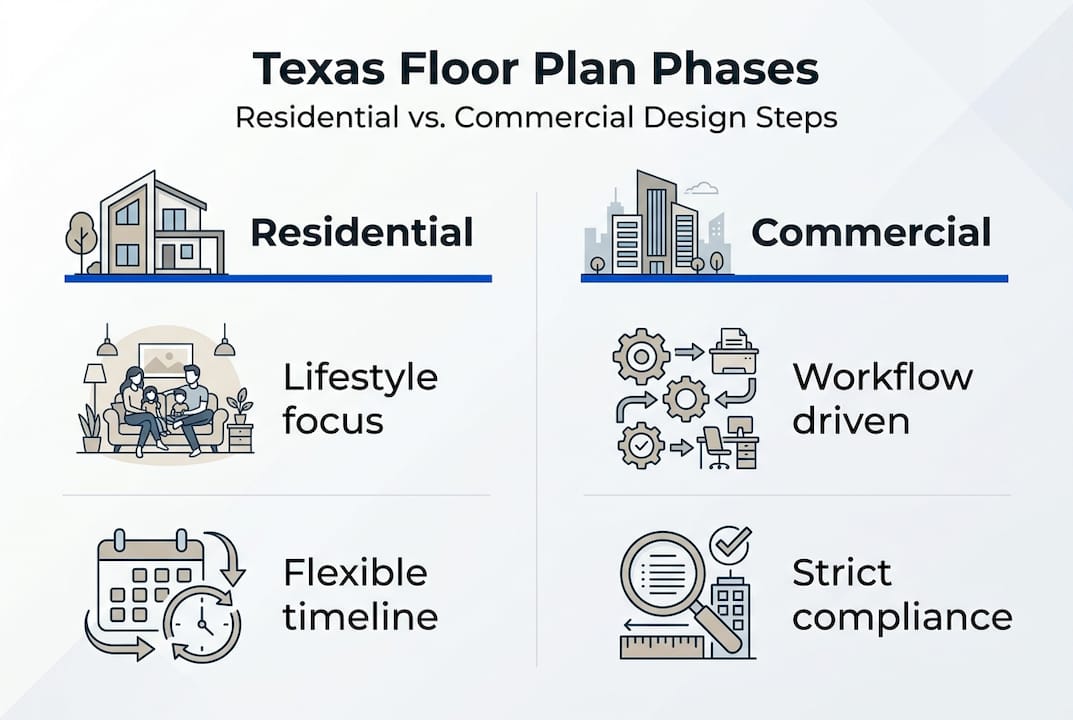
Texas residential and commercial projects follow distinct design processes tailored to regulatory demands and functional goals. For residential builds, the residential floor plan design process includes pre-design, schematic design, engineering, permitting with timelines of 10-18 months and costs varying by plan complexity. Homeowners start with discovery meetings to define needs, then move through schematic layouts, detailed construction documents, and engineering reviews before submitting for permits. Each phase builds on the last, ensuring the final plan integrates lifestyle priorities with structural integrity.
Commercial projects demand a different approach. Commercial floor plan design emphasizes workflow optimization and compliance with IBC, TAS, with required sealed plans and phased inspections by licensed professionals. Architects and engineers collaborate to create multi-functional spaces that support customer flow, employee efficiency, and safety codes. Unlike residential plans, commercial designs undergo stricter scrutiny during permit review, often requiring fire marshal approvals, ADA compliance checks, and utility coordination before construction begins.
Permit review times vary significantly across Texas cities. Houston typically processes residential permits in 2-4 weeks, while commercial applications can take 6-8 weeks depending on project scope. Austin and Dallas follow similar timelines but may extend reviews if plans require variance approvals or environmental assessments. Understanding these purpose of building plans Texas requirements early helps you schedule design milestones realistically.
Here’s a chronological breakdown of the design process:
- Discovery and site analysis to assess soil conditions, setbacks, and zoning restrictions
- Schematic design phase to draft initial layouts and spatial relationships
- Design development to refine dimensions, materials, and mechanical systems
- Construction documentation to produce detailed drawings for permitting and bidding
- Engineering review to validate structural, electrical, and plumbing designs
- Permit submission with all required stamps, calculations, and compliance documents
- Revision cycles to address reviewer comments and code clarifications
- Final approval and construction readiness with inspections scheduled
Key permits and documentation for Texas projects include:
- Building permits with sealed architectural and engineering plans
- Site plans showing property boundaries, easements, and drainage
- Foundation plans with soil reports and structural calculations
- MEP drawings detailing mechanical, electrical, and plumbing systems
- Energy compliance forms demonstrating insulation and HVAC efficiency
- Fire safety plans for commercial occupancies over certain square footages
The table below compares residential and commercial process phases:
| Phase | Residential Timeline | Commercial Timeline | Regulatory Checks |
|---|---|---|---|
| Pre-design | 2-4 weeks | 4-6 weeks | Zoning, setbacks, easements |
| Schematic design | 4-6 weeks | 6-10 weeks | Code review, ADA compliance |
| Design development | 6-8 weeks | 8-12 weeks | Structural loads, fire safety |
| Construction docs | 8-12 weeks | 12-16 weeks | Full code compliance, sealed plans |
| Permitting | 2-6 weeks | 6-10 weeks | City reviews, utility approvals |
Professional involvement matters throughout these phases. Architects handle spatial design and code compliance, while engineers validate structural integrity and foundation systems. Contractors provide constructability feedback, catching design flaws that could inflate costs during building. For a complete overview of what’s needed, review this Texas residential construction checklist and understand construction plans purpose Texas requirements before starting your project.
Key design principles and practical tools for accurate floor plans
Accurate measurements form the foundation of functional floor plans. Accurate measurements using laser/tape and well-scaled drawings are essential; zoning, circulation, and furniture fit testing improve spatial functionality. Laser distance meters eliminate human error when recording room dimensions, while traditional tape measures work well for verifying door and window placements. Always measure twice and record dimensions in a consistent format to avoid confusion during drafting.

Layout standards ensure spaces feel comfortable and meet code requirements. Hallways should measure at least 36 inches wide for single-person passage, with 42-48 inches preferred for high-traffic areas. Doorways require 32-36 inch clearances for accessibility, and kitchen work triangles should keep sink, stove, and refrigerator within 4-9 feet of each other for efficient meal preparation. Bedrooms need adequate wall space for furniture placement, typically 10×12 feet minimum for a queen bed and nightstands.
Critical design checks before finalizing plans:
- Natural light placement with windows on at least two walls per room
- Furniture fit testing using scaled templates or digital models
- Door swing clearances to prevent collisions with fixtures or other doors
- Circulation paths that allow smooth movement between rooms without bottlenecks
- Privacy zoning that separates public entertaining areas from private bedrooms
- Storage allocation with closets sized appropriately for each room’s function
Pro Tip: Use digital design software like SketchUp or Floorplanner early in the process to create virtual walkthroughs. Walking through your design digitally reveals awkward transitions, tight corners, and lighting issues that aren’t obvious on paper, saving thousands in revision costs later.
Design dimension benchmarks for Texas homes:
| Element | Minimum Dimension | Recommended Dimension |
|---|---|---|
| Interior doors | 30 inches | 32-36 inches |
| Hallways | 36 inches | 42-48 inches |
| Kitchen work triangle | 12 feet total | 15-22 feet total |
| Master bedroom | 10×12 feet | 12×16 feet |
| Stair width | 36 inches | 42-48 inches |
| Garage depth | 20 feet | 22-24 feet |
Testing your design for flow and comfort prevents regrets after construction. Print floor plans at scale and use furniture cutouts to simulate room arrangements. Walk through the layout mentally, considering daily routines like morning bathroom access, kitchen workflow during meal prep, and evening relaxation paths. Ask whether the design supports your lifestyle or forces awkward compromises. This construction plan essentials Texas homes resource explains additional verification steps that catch problems before they become expensive fixes.
Navigating Texas-specific challenges: soil, flooding, and permitting nuances
Texas presents unique environmental factors that directly impact floor plan design decisions. Regional challenges affecting your project include:
- Expansive clay soils that swell and shrink with moisture changes, stressing foundations
- Floodplain designations requiring elevated first floors and flood-resistant materials
- Hurricane wind loads in coastal areas demanding reinforced connections and impact-resistant windows
- Extreme heat necessitating strategic window placement and insulation upgrades
- Water table variations affecting basement feasibility and drainage systems
Expansive clay soils require post-tension foundations affecting load paths; floodplains mandate elevated floors; permitting demands architect/engineer stamps and adherence to local building codes. Foundation engineering must happen before you finalize interior layouts because slab design, pier placement, and load-bearing walls constrain where you can position rooms and openings. Skipping this step leads to expensive redesigns when structural engineers identify conflicts between your floor plan and foundation requirements.
Pro Tip: Engage design-build firms early to integrate engineering, permitting, and construction expertise from day one. This collaborative approach identifies soil issues, code conflicts, and constructability problems during schematic design rather than after you’ve invested in detailed drawings, cutting revision cycles by 30-40%.
Ignoring soil conditions and floodplain regulations during design adds $15,000-$50,000 in foundation modifications and delays projects by 8-16 weeks when problems surface during permitting or construction.
Common mistakes reveal the cost of overlooking Texas-specific factors. North-facing master bedrooms in Houston suffer from limited natural light and feel dim year-round. Placing garages more than 30 feet from kitchens creates frustrating grocery hauls, especially in summer heat. Designing single-story homes in floodplains without elevation surveys results in permit denials and complete redesigns. These errors stem from generic floor plans that ignore local climate, topography, and regulatory nuances.
Texas construction follows a phased inspection process to ensure code compliance. Mid-build changes triggered by poor site consideration or dimension errors are costly; phased inspections (foundation, framing, MEP) are standard in Texas commercial projects. Residential builds undergo similar scrutiny with foundation inspections before concrete pours, framing inspections before drywall installation, and final inspections before occupancy certificates. Each inspection validates that construction matches approved plans, making accurate floor plan design essential to avoid stop-work orders.
Understanding construction plans Texas homeowners need and the engineers role in Texas permitting helps you prepare documentation that satisfies reviewers on first submission. Engineers provide sealed calculations for structural loads, foundation systems, and wind resistance that permit offices require before approving commercial and many residential projects. Without these stamps, your application sits in limbo regardless of how well-designed your floor plan appears.
Avoiding common mistakes and ensuring successful project outcomes
Floor plan errors cost time and money, but knowing what to watch for keeps projects on track. The comparison below highlights frequent mistakes and recommended fixes:
| Common Mistake | Impact | Best Practice |
|---|---|---|
| Skipping dimension verification | 21% error rate, costly framing changes | Measure twice, use laser tools, verify with contractor |
| Ignoring natural light placement | Dark rooms, poor livability | Position windows on multiple walls per room |
| Overlooking furniture fit | Cramped spaces, layout regrets | Test with scaled templates before finalizing |
| Neglecting privacy zoning | Noise bleed, awkward guest interactions | Separate public and private areas clearly |
| Missing MEP coordination | Ductwork and plumbing conflicts | Engage mechanical engineers during design |
Skipping dimension checks leads to 21% errors; poor light, privacy, and flow cause regrets; working closely with MEP and structural experts avoids costly revisions. Verification steps validate your design before construction begins:
- Cross-check all dimensions against site survey and foundation plans
- Confirm door and window placements allow proper furniture arrangements
- Verify circulation paths meet code widths and avoid dead ends
- Test natural light distribution at different times of day using sun path analysis
- Review mechanical, electrical, and plumbing routes for conflicts with structural elements
- Validate code compliance for egress, fire safety, and accessibility requirements
- Obtain contractor feedback on constructability and cost implications
- Secure engineer stamps for structural, foundation, and specialty systems
Pro Tip: Incorporate contractor and engineering feedback during schematic design rather than after construction documents are complete. Early collaboration catches dimension errors, code violations, and constructability issues when changes cost hundreds instead of thousands, improving permit approval rates by 40%.
Ignoring these verification steps creates risks that compound during construction. Dimension errors discovered during framing require wall relocations, window reorders, and schedule delays. Poor lighting identified after drywall installation means expensive fixture additions or skylight retrofits. Flow problems recognized at move-in leave you stuck with awkward layouts that diminish home value and daily comfort.
Thorough permitting preparation smooths approval timelines in Texas. Reviewers expect complete documentation including sealed plans, energy calculations, site drainage details, and code compliance narratives. Missing any element triggers rejection letters that restart the review clock. Design-build and contractor input reduce mid-build changes and improve plan accuracy and permitting success in Texas by ensuring plans reflect real-world construction methods and local code interpretations.
Final reviews should involve your entire project team. Walk through plans with your contractor to identify material conflicts or sequencing problems. Have your engineer verify that structural elements align with architectural layouts. Confirm with your architect that all code requirements are documented and calculations support design choices. This collaborative final check catches last-minute issues before you submit for permits, reducing revision cycles and keeping projects on schedule. Review types of construction plans Texas homeowners need and understand commercial vs residential engineering Texas differences to ensure your documentation package is complete.
How Texas Licensed Engineers can support your floor plan design project
Navigating Texas floor plan design becomes significantly easier when you work with experienced engineering professionals who understand local regulations and site challenges. Texas Licensed Engineers provides comprehensive services including structural inspections, foundation analysis, and engineering plan preparation that ensure your design meets code requirements from the start. Our team specializes in addressing expansive clay soil issues, floodplain compliance, and wind load calculations that are critical for Texas projects.

We streamline communication between architects, contractors, and permit offices, reducing revision cycles and approval delays. Whether you’re planning a residential custom home or a commercial build, our expertise in construction plans Texas homeowners and businesses need helps you avoid costly mistakes. Our engineers provide sealed calculations and stamped drawings that satisfy permit reviewers, while our inspection services verify construction matches approved plans. Following this Texas residential construction checklist with professional engineering support ensures safer, compliant builds that protect your investment. Contact us to discuss how our understanding of the engineers role in Texas permitting can make your next project smoother and more successful.
FAQ
What is the typical timeline for a residential floor plan design in Texas?
Residential design phases plus permitting typically take 10-18 months in Texas, depending on project complexity and customization level. Simple plans with minimal engineering needs move faster, while custom designs requiring extensive structural calculations and multiple permit revisions extend timelines. Starting with clear goals and engaging professionals early helps keep your project on the shorter end of this range.
What environmental factors must be considered in Texas floor plan design?
Texas expansive clay soils require special foundation engineering; floodplains often mandate elevated floors to prevent structural damage and meet insurance requirements. Coastal areas face additional hurricane wind load requirements that influence wall construction and window specifications. Site-specific engineering assessments identify these factors before design begins, preventing expensive mid-construction modifications.
How do commercial and residential floor plan design processes differ in Texas?
Commercial design prioritizes workflow, multi-use zones, and strict code compliance with sealed plans and phased inspections, differing from residential emphasis on family flow and outdoor integration. Commercial projects undergo more rigorous permit reviews including fire marshal approvals, ADA compliance checks, and utility coordination. Residential designs focus on lifestyle comfort, privacy zoning, and aesthetic preferences while meeting basic building codes.
Why is early engineer involvement important in Texas floor plan design?
Early engineer involvement helps address soil challenges, ensures proper foundation design, and smooths permitting to prevent expensive mid-build modifications. Engineers identify load-bearing requirements, structural conflicts, and code issues during schematic design when changes cost less. Their sealed calculations and stamped drawings are required for permit approval on most Texas projects, making their input essential rather than optional.
What are the most common floor plan mistakes in Texas projects?
Dimension errors, inadequate natural light, and poor circulation planning top the list of costly mistakes. Failing to account for Texas-specific factors like expansive soils and floodplain regulations leads to foundation problems and permit denials. Skipping contractor and engineer reviews during design results in constructability issues discovered after construction begins, adding thousands in change orders and schedule delays.
Recommended
- 6 Must-Know Construction Plan Essentials for Texas Homes – Texas Licensed Engineers
- 7 Types of Construction Plans Every Texas Homeowner Needs – Texas Licensed Engineers
- Construction Plans: Key Insights for Texas Homeowners – Texas Licensed Engineers
- 7 Practical Examples of Site Plans for Texas Projects – Texas Licensed Engineers
- 10 Tips for Designing Your Dream Custom Home


