
Engineering permits in Texas homes and projects 2026

Many Texas homeowners and contractors assume engineering permits are optional paperwork, but this misconception leads to costly fines, stop-work orders, and legal headaches. Engineering permits are legally required for most residential and commercial projects to ensure structural safety, code compliance, and public welfare. In 2026, understanding Texas permit requirements, processes, risks of noncompliance, and practical steps protects your investment and keeps projects on track. This guide clarifies the legal landscape, walks through the permitting process, and explains how to navigate special cases efficiently.
Table of Contents
- Why Engineering Permits Matter For Texas Homeowners And Contractors
- Understanding The Texas Engineering Permit Process And Requirements
- Consequences Of Not Obtaining Proper Engineering Permits In Texas
- Special Cases And Practical Tips For Engineering Permits In Texas Projects
- Get Expert Help With Your Texas Engineering Permits
- Frequently Asked Questions
Key takeaways
| Point | Details |
|---|---|
| Legal requirement | Engineering permits are legally required in Texas for most residential and commercial projects to ensure safety and code compliance. |
| Local enforcement | Local jurisdictions enforce permits often requiring Professional Engineer sealed plans for structural elements. |
| Complete documentation | Submitting complete sealed plans and inspections prevents costly delays and legal penalties. |
| Noncompliance risks | Failing to obtain proper permits risks fines, stop-work orders, and property issues. |
| Process understanding | Understanding Texas permit steps helps homeowners and contractors secure compliance efficiently. |
Why engineering permits matter for Texas homeowners and contractors
Permits ensure compliance with structural safety standards and protect public welfare. Engineering permits in Texas, particularly those requiring sealed engineering plans, are crucial for ensuring structural safety, code compliance, and public welfare in residential and commercial projects. Local jurisdictions require professional engineer (PE) sealed plans, especially in high-risk zones like floodplains or coastal areas where environmental factors create additional structural demands.
Permits validate projects against Texas building codes based on International Building Code (IBC) and International Residential Code (IRC). These codes establish minimum standards for structural integrity, fire safety, electrical systems, plumbing, and mechanical installations. Without proper permits, projects may violate these standards, creating dangerous conditions for occupants and neighboring properties.
They prevent construction defects, reduce liability risks under Texas law, and safeguard property investment. When construction proceeds without permits, defects often go undetected until catastrophic failure occurs. Legal backing comes from the Texas Engineering Practice Act and TBPELS regulations, which mandate that only licensed professional engineers can seal structural plans and calculations.
“Permits serve as quality control checkpoints, ensuring that every phase of construction meets established safety benchmarks and protects both current occupants and future buyers.”
The engineers role in permitting extends beyond plan preparation to include ongoing collaboration with building officials during inspections. Engineers verify that contractors follow approved plans and address any field conditions requiring design modifications. This collaborative oversight prevents shortcuts that compromise structural integrity.
Key reasons permits matter:
- Structural safety validation through third-party review
- Legal protection against liability claims
- Property value preservation for resale
- Insurance coverage compliance
- Public welfare protection in shared infrastructure zones
Pro Tip: Even if your contractor suggests skipping permits to save time or money, insist on full compliance. The short-term savings pale compared to long-term legal and financial consequences.
Understanding the Texas engineering permit process and requirements
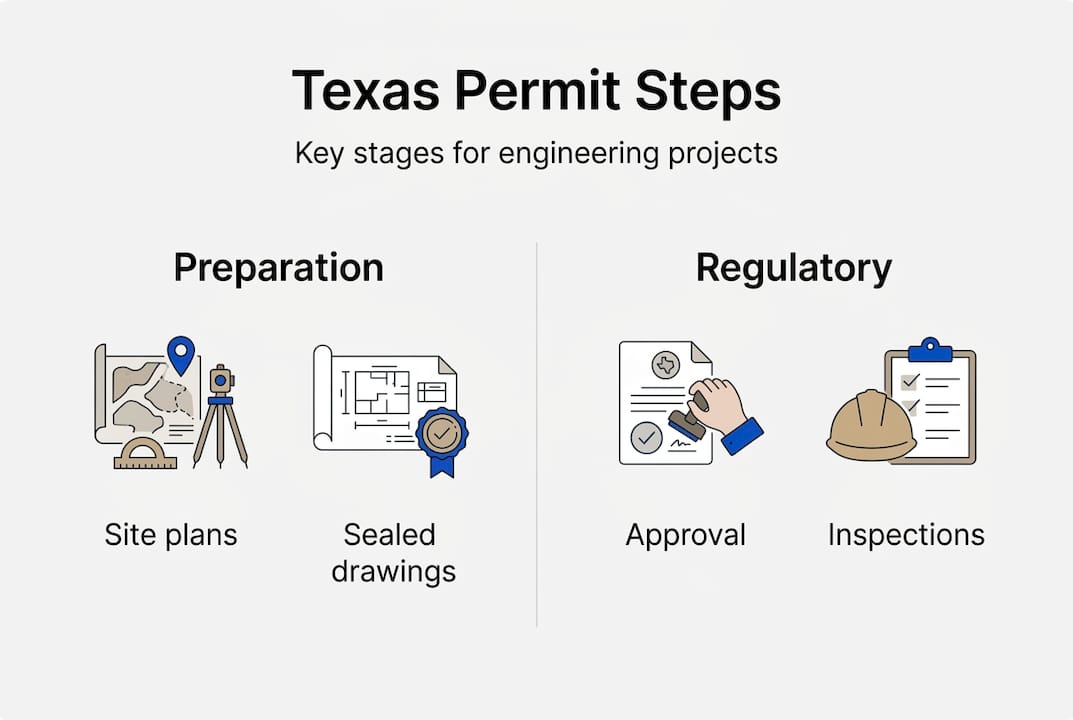
Permit applications need site plans and all structural, mechanical, electrical, plumbing (MEP) drawings sealed by a Texas PE. The Texas residential construction checklist outlines documentation requirements that vary by project scope and local jurisdiction. Site plans must show property boundaries, setbacks, easements, existing structures, and proposed improvements with precise dimensions.

Following submission, the local building department conducts review and charges permit fees. Residential permit fees typically start at $200 and scale based on project valuation, while commercial projects face higher fees reflecting increased review complexity. Review timelines range from two weeks for straightforward residential additions to six weeks or more for complex commercial structures requiring coordination across multiple departments.
Permits must be posted visibly on site; inspections occur in phases:
- Foundation inspection before concrete pour
- Framing inspection after structural elements are in place but before concealment
- Rough-in inspection for MEP systems before walls close
- Final inspection verifying code compliance and safe occupancy
Special conditions apply in floodplains, coastal zones requiring additional erosion control or windstorm compliance. Projects in FEMA-designated flood zones must meet elevated foundation requirements and provide flood venting details. Coastal properties face stricter wind load calculations and impact-resistant glazing mandates under the Texas Windstorm Insurance Association (TWIA) guidelines.
Small projects like fences or driveways often still need permits; larger earth disturbances trigger stormwater permits. Any land disturbance exceeding one acre requires a stormwater permit from TCEQ, including erosion control plans and sediment retention measures. Even smaller projects may need permits if they affect drainage patterns or impervious cover ratios.
| Permit Type | Typical Fee Range | Review Timeline | Common Requirements |
|---|---|---|---|
| Residential Addition | $200 to $800 | 2 to 4 weeks | Sealed structural plans, site plan, energy calculations |
| Commercial New Construction | $2,000 to $15,000+ | 4 to 8 weeks | Full MEP drawings, accessibility compliance, fire protection |
| Foundation Repair | $150 to $500 | 1 to 2 weeks | Geotechnical report, PE-sealed repair plan |
| Drainage Modification | $100 to $400 | 1 to 3 weeks | Grading plan, stormwater analysis |
Pro Tip: Double-check local amendments or extraterritorial jurisdiction (ETJ) requirements to avoid rejections or delays. Many Texas cities enforce building codes beyond city limits in ETJ areas, catching rural property owners by surprise. Contact the local building department early to confirm which jurisdiction governs your project and obtain their specific submittal checklist.
Understanding why to use licensed engineers becomes clear when navigating these complex requirements. Licensed engineers maintain current knowledge of code updates, local amendments, and submittal procedures that streamline approval. Their professional liability insurance also protects you if design errors occur. The residential construction planning guide provides additional preparation strategies for Houston-area homeowners facing unique soil and drainage challenges.
Consequences of not obtaining proper engineering permits in Texas
Ignoring permit requirements can lead to stop-work orders and fines ranging from $500 to $20,000 or more. Local building officials have authority to halt construction immediately upon discovering unpermitted work, leaving projects incomplete and contractors unpaid until compliance is achieved. Each day of continued violation may accrue additional daily fines, compounding financial penalties rapidly.
TBPELS disciplines engineers and contractors who seal unauthorized plans or practice without a license. Disciplinary actions include license suspension, revocation, and civil penalties up to $5,000 per violation. Engineers who seal plans outside their competency area or without proper site investigation face professional consequences that end careers. Contractors who misrepresent engineering credentials or use unlicensed individuals to prepare plans risk criminal charges.
Insurance may not cover damages from unpermitted work; resale value and buyer confidence suffer. Homeowners insurance policies typically exclude coverage for code violations and unpermitted modifications. When structural failure occurs in unpermitted work, insurers deny claims, leaving property owners personally liable for damages and injuries. During real estate transactions, title companies flag unpermitted improvements, requiring expensive retroactive permitting or value reductions.
Examples include a $16,000 fine in Comal County for unpermitted construction impacting the Edwards Aquifer. This case involved land clearing and construction within the aquifer recharge zone without required permits, threatening groundwater quality for thousands of residents. The property owner faced not only fines but also mandatory remediation costs and ongoing monitoring requirements.
“The financial and legal consequences of skipping permits far exceed any perceived savings. One unpermitted project can trigger cascading problems that haunt property owners for decades.”
Legal and financial consequences emphasize the need to follow all engineering permit laws meticulously. Beyond immediate fines, unpermitted work creates long-term liabilities:
- Forced demolition of unpermitted structures
- Inability to obtain certificates of occupancy
- Mortgage refinancing complications
- Increased property tax assessments without corresponding value
- Personal injury liability if structural failure causes harm
Knowing when to call an engineer prevents these scenarios by ensuring proper planning before construction begins. Engineers identify permit requirements during initial consultations, allowing you to budget accurately and schedule realistically. The value of using licensed engineers becomes evident when comparing the cost of proper permitting against the potential penalties and remediation expenses for unpermitted work.
Special cases and practical tips for engineering permits in Texas projects
Distinguishing project types helps determine when small projects still require permits versus those needing full engineering plans. Fences over six feet tall, driveways that alter drainage patterns, and decks attached to structures typically require permits even though they seem minor. Detached accessory structures under 200 square feet may be exempt in some jurisdictions but not others, making local verification essential.
Comparing commercial vs residential permit differences reveals distinct requirements for each project type. Commercial versus residential engineering involves different code sections, occupancy classifications, and accessibility mandates. Commercial projects require fire protection systems, emergency egress calculations, and ADA compliance that residential projects may not. The permit review process for commercial work involves more departments and longer timelines.
| Project Characteristic | Residential Requirements | Commercial Requirements |
|---|---|---|
| Structural Plans | PE seal for load-bearing modifications | PE seal for all structural elements |
| Accessibility | Basic doorway widths, bathroom clearances | Full ADA compliance, accessible routes |
| Fire Protection | Smoke detectors, residential sprinklers in new construction | Commercial sprinkler systems, fire alarm systems |
| Energy Code | Simplified prescriptive path available | Performance-based energy modeling often required |
Expansive soils in much of Texas necessitate geotechnical reports for foundation design. Clay soils expand when wet and shrink when dry, creating significant foundation movement that cracks slabs and damages structures. Engineers use geotechnical data to specify foundation depth, reinforcement, and moisture control measures preventing these problems. Projects on lots with previous foundation issues or near large trees require especially detailed soil analysis.
Large land disturbances exceeding one acre trigger TCEQ stormwater permits requiring erosion control plans and regular inspections. These permits mandate specific best management practices like silt fences, sediment basins, and stabilized construction entrances. Contractors must conduct weekly inspections and maintain records demonstrating compliance throughout the construction period. Violations result in notices of enforcement and potential project shutdowns.
Hardship variances provide relief when strict permit requirements cause undue burden, though approval is not guaranteed. Property owners must demonstrate that unique site conditions, not general inconvenience or cost, create the hardship. Variance applications require detailed justification, often including engineering analysis showing that alternative compliance methods achieve equivalent safety. Public hearings allow neighbors to comment, and boards of adjustment make final decisions.
Practical tips for smooth permitting:
- Schedule pre-application meetings with building officials to clarify requirements
- Obtain surveys and geotechnical reports before design begins
- Budget 10% contingency for plan revisions and resubmittals
- Track inspection scheduling carefully to avoid construction delays
- Maintain organized permit documentation for future reference
Pro Tip: Consult licensed engineers early to identify required permits and prepare complete sealed documentation to avoid rejections. Engineers familiar with local building departments understand specific preferences and common review comments, allowing them to prepare submittals that pass review quickly. Their experience navigating the engineers role in permitting saves you time and frustration while ensuring full compliance.
Get expert help with your Texas engineering permits
Navigating Texas engineering permits requires expertise that protects your investment and ensures compliance. Professional engineers streamline the permit application and approval process by preparing complete, code-compliant documentation that passes review on the first submission. They help ensure sealed plans meet local building codes and avoid costly errors that lead to rejections, delays, or unsafe construction.

Connect with licensed Texas engineers experienced in residential and commercial permits who understand local jurisdiction requirements across Houston, Austin, Dallas, San Antonio, and beyond. Their knowledge of the engineers role in permitting ensures your project proceeds smoothly from initial design through final inspection. Resources like the Texas residential construction checklist help prepare you for inspections and compliance milestones.
Don’t risk fines, delays, or structural problems by attempting complex permitting alone. Using licensed engineers provides peace of mind that your project meets all legal requirements and protects your property value for years to come.
Frequently asked questions
What projects require engineering permits in Texas?
New construction, structural modifications, foundation work, and large earth disturbances typically require permits with PE-sealed plans. Small projects like fences over six feet, driveways altering drainage, and attached decks also need permits in most jurisdictions. Permitting varies widely by city or county due to Texas’s decentralized system, so always verify local requirements before starting work.
How long does it take to get engineering permits approved in Texas?
Approval times depend on local building departments, ranging from two weeks for simple residential projects to over six weeks for complex commercial structures. Incomplete or unsealed plans frequently cause delays and rejections, extending timelines significantly. Early communication with the local building department and submission of complete documentation expedites the process and prevents costly resubmittals.
What are the consequences of not getting proper permits in Texas?
Penalties include fines from $500 to $20,000 or more, stop-work orders, increased insurance costs, and possible demolition of unpermitted structures. Licensing boards may impose sanctions on professionals who seal improper plans, including license suspension and civil penalties. Unpermitted work causes resale difficulties, title problems, and legal liability if structural failure leads to property damage or injuries.
Do I need a licensed engineer for residential remodeling in Texas?
You need a licensed engineer when remodeling involves load-bearing wall removal, foundation modifications, or structural changes affecting building integrity. Even non-structural remodels require permits for electrical, plumbing, and mechanical work, though these may not need engineering seals. Consulting an engineer early identifies which aspects of your remodel require professional design and ensures all permit requirements are met before construction begins.
Recommended
- Home Expansion Engineering Needs in Texas Homes – Texas Licensed Engineers
- Engineers in Permitting – Key to Texas Project Success – Texas Licensed Engineers
- Defining Civil Engineering Services in Texas Homes – Texas Licensed Engineers
- Engineering Inspections, Reports & Permit Plan Sets in Texas | Texas Licensed Engineers


