
How to Read Engineering Reports for Texas Projects
Sorting through engineering reports can feel daunting for Texas homeowners and contractors planning residential projects in Houston, Austin, Dallas, and San Antonio. These reports are filled with critical information that shapes project safety, compliance, and budget decisions. By focusing on essential documents, key report sections, and decoding technical language, you will develop confidence and clarity when working with engineers and city officials, ensuring your next project starts on solid ground.
Table of Contents
- Step 1: Gather Essential Documents For The Report
- Step 2: Identify Key Sections In The Engineering Report
- Step 3: Interpret Technical Language And Visuals
- Step 4: Verify Findings Against Your Project Needs
- Step 5: Confirm Next Steps And Recommendations
Quick Summary
| Key Point | Explanation |
|---|---|
| 1. Gather Essential Documents | Collect key project materials to establish a solid foundation for your engineering report. |
| 2. Understand Report Structure | Familiarize yourself with standard sections to effectively extract and analyze project insights. |
| 3. Decode Technical Language | Use a glossary and compare visuals with text to clarify complex engineering terminology and data. |
| 4. Verify Findings Against Needs | Systematically check report findings for alignment with your project’s specific requirements and local regulations. |
| 5. Analyze Recommendations Carefully | Evaluate proposed actions and develop a strategic plan for project implementation to ensure clarity and success. |
Step 1: Gather essential documents for the report
Successfully preparing an engineering report for a Texas project starts with gathering the right documentation. This initial step provides the critical foundation for a comprehensive and professional analysis that will guide your project’s development.
Begin by collecting key preparatory materials from multiple sources. The Texas Department of Transportation project development process recommends assembling the following essential documents:
- Project selection materials
- Public involvement documentation
- Environmental review reports
- Feasibility studies
- Funding strategy documents
Your document collection should be systematic and thorough. Contact local and regional authorities directly to obtain comprehensive paperwork. Some engineering departments might require specific forms or have unique submission requirements for Texas projects.
Follow the recommended reporting guidelines to ensure your documentation includes critical elements such as:
- Clear project introduction
- Defined project scope
- Detailed procedures
- Obtained data
- Preliminary conclusions or recommendations
Preparing these documents meticulously will streamline your engineering report preparation and demonstrate professional thoroughness.

The following table compares common report documentation sources and their contribution to Texas engineering project analysis:
| Source Type | Typical Documents Provided | Impact on Project Analysis |
|---|---|---|
| Local Authorities | Permits, zoning information | Ensures regulatory compliance |
| Regional Transportation Dept | Traffic studies, road usage data | Guides design and feasibility checks |
| Environmental Agencies | Site surveys, impact statements | Identifies ecological constraints |
| Engineering Departments | Technical forms, assessment sheets | Supports technical validation |
| Community Stakeholders | Public comments, meeting notes | Addresses social and economic factors |
Pro tip: Create a digital and physical backup of all collected documents to prevent potential loss or damage during the project development process.
Step 2: Identify key sections in the engineering report
Understanding the standard structure of an engineering report is crucial for effectively interpreting its contents and extracting valuable project insights. Each section serves a specific purpose in communicating technical information systematically.
According to standard technical document guidelines, engineering reports typically include these essential sections:
Front Matter Sections:
- Title page
- Executive summary
- Table of contents
Body Sections:
- Introduction
- Background information
- Methodology description
- Results and findings
- Technical analysis
- Discussion of results
End Matter Sections:
- Conclusions
- Recommendations
- References
- Appendices
Carefully examine each section to understand its purpose. The technical documentation standards recommend paying special attention to the introduction, which outlines project objectives, and the methodology section, which explains how data was collected and analyzed.
Each section provides critical context for understanding the engineering report’s overall findings and implications for your Texas project.
This table summarizes how different engineering report sections inform project decisions:
| Section | Decision Support Provided | Typical Use in Texas Projects |
|---|---|---|
| Introduction | Sets project objectives | Clarifies goals for stakeholders |
| Methodology | Explains analysis approach | Validates data collection methods |
| Results | Presents findings | Guides technical adjustments |
| Recommendations | Proposes actions | Directs implementation planning |
| References | Documents information sources | Ensures transparency and accuracy |
Pro tip: Create a quick reference checklist of these key sections before diving into the report to ensure you don’t miss any crucial information.
Step 3: Interpret technical language and visuals
Deciphering the complex language and visual elements in an engineering report requires a strategic approach that combines technical knowledge and careful analysis. Understanding these components will help you extract critical insights about your Texas project.
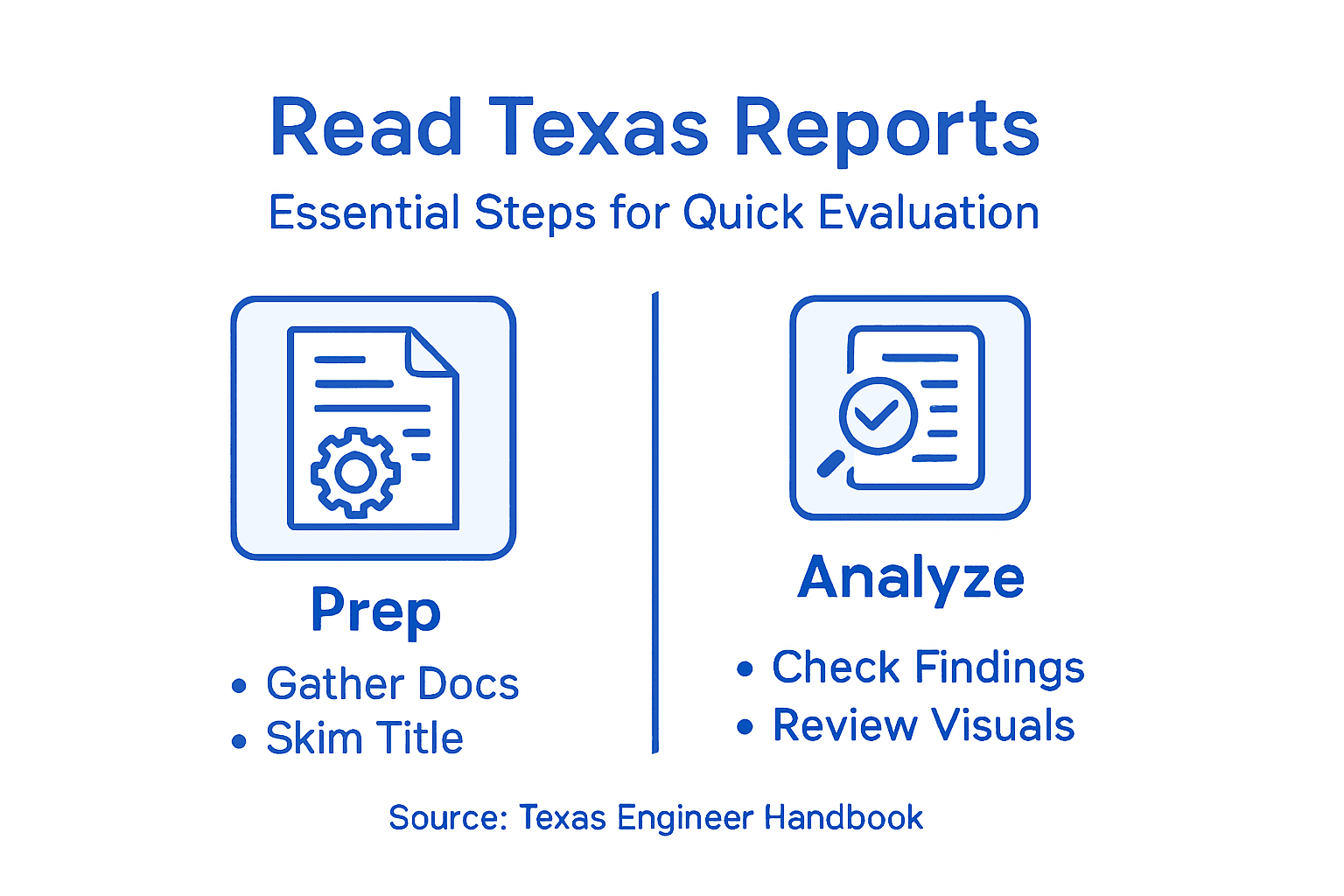
The engineering writing standards emphasize the importance of breaking down technical terminology and visual representations systematically. Here are key strategies for effective interpretation:
Technical Language Strategies:
- Create a personal glossary of specialized terms
- Highlight unfamiliar engineering terminology
- Cross-reference definitions from technical dictionaries
- Ask experts for clarification when needed
Visual Element Interpretation:
- Understand the type of visual representation
- Read all labels and captions carefully
- Note the data source and date
- Compare visual data with written explanations
- Look for trends and significant patterns
According to technical writing guidelines, visuals must be clearly labeled and referenced within the text. Pay special attention to charts, graphs, diagrams, and tables that provide critical project insights.
Professional engineers use precise language and visuals to communicate complex technical information accurately.
Pro tip: Keep a technical dictionary or online engineering reference handy while reading to quickly decode specialized terminology and symbols.
Step 4: Verify findings against your project needs
Validating the engineering report’s findings against your specific project requirements is a critical step in ensuring accurate and actionable insights for your Texas construction or development project. This process involves a systematic review of the report’s recommendations and technical details.
The Texas environmental review guidance emphasizes the importance of cross-checking report conclusions with project-specific requirements. Here are key verification strategies:
Critical Verification Checkpoints:
- Confirm alignment with project scope
- Verify compliance with local regulations
- Check data accuracy and relevance
- Assess methodology thoroughness
- Evaluate potential environmental impacts
Comprehensive Review Process:
- Compare report findings with original project objectives
- Review technical specifications in detail
- Validate data sources and collection methods
- Cross-reference with local Texas building codes
- Identify any potential discrepancies or limitations
According to Texas A&M University reporting guidelines, critical assessment involves ensuring that report findings genuinely support your project’s practical needs and stakeholder expectations.
Rigorous verification prevents costly mistakes and ensures your project meets all necessary technical and regulatory standards.
Pro tip: Create a side-by-side comparison worksheet to systematically track how each report finding matches your specific project requirements.
Step 5: Confirm next steps and recommendations
Navigating the final section of an engineering report requires careful analysis of proposed actions and strategic planning for your Texas project. Understanding the recommendations will help you chart a clear path forward and make informed decisions.
The engineering report recommendation guidelines suggest thoroughly examining the concluding sections for actionable insights. Here are key strategies for evaluating recommendations:
Recommendation Analysis Checklist:
- Prioritize proposed actions
- Assess feasibility of recommendations
- Evaluate potential resource requirements
- Identify potential risks or challenges
- Determine implementation timeline
Strategic Next Steps:
- Review each recommendation critically
- Compare recommendations against project goals
- Analyze cost implications
- Consult with project stakeholders
- Develop an implementation strategy
According to technical report guidelines, the recommendations should provide clear guidance for moving your project forward efficiently.
Thoughtful analysis of recommendations transforms technical insights into actionable project strategies.
Pro tip: Create a decision matrix to systematically evaluate and prioritize each recommendation based on impact, cost, and feasibility.
Master the Art of Reading Engineering Reports with Expert Texas Licensed Engineers
Struggling to interpret complex engineering reports for your Texas projects can lead to costly mistakes and delays. This article highlighted common challenges such as understanding technical language, verifying findings, and aligning recommendations with your project needs. Whether you are dealing with structural inspections, foundation analysis, or construction plans, our experienced team at Texas Licensed Engineers simplifies this process for you by providing clear, reliable engineering interpretations tailored to local codes and regulations.

Ready to confidently navigate your engineering reports and ensure project success? Visit our TLE Archives – Texas Licensed Engineers | Residential & Commercial to explore practical solutions including forensic investigations for flood damage or drainage issues. Start now with trusted professionals who understand technical intricacies and deliver actionable recommendations. Don’t let confusing reports hold your project back. Connect with Texas Licensed Engineers and turn complex reports into clear steps toward your construction goals.
Frequently Asked Questions
What documents should I gather before reading an engineering report for Texas projects?
To prepare for reading an engineering report, you should gather crucial documents such as project selection materials, environmental review reports, and funding strategy documents. Collect these materials systematically to ensure you have the foundational information needed for your project analysis.
How can I identify the key sections in an engineering report?
To identify key sections in an engineering report, look for the systematic structure that includes front matter, body, and end matter sections. Familiarize yourself with these sections, such as the introduction and methodology, to better understand their purpose and how they guide project insights.
What strategies can I use to interpret technical language in engineering reports?
To effectively interpret technical language, create a personal glossary of terms that you encounter while reading. Highlight unfamiliar terms and cross-reference them with technical dictionaries to clarify their meanings for better comprehension.
How do I verify the findings in an engineering report against my project needs?
To verify findings, compare the engineering report’s conclusions with your specific project requirements and local regulations. Create a checklist to assess data accuracy, methodology thoroughness, and compliance with the project scope to ensure alignment with your needs.
What should I focus on in the recommendations section of an engineering report?
In the recommendations section, prioritize proposed actions and assess their feasibility. Review each recommendation critically, analyze potential resource requirements, and consult with stakeholders to create a clear implementation strategy.
Recommended
- How to Read an Engineering Report for Clear Results – FloridaLicensedEngineers.com
- How to Read an Engineering Report for Clear Results – Florida Licensed Engineers
- Structural Engineering Guide 2025 for Texas Projects – Texas Licensed Engineers | Residential & Commercial
- How to Choose Texas Engineering Firm for Your Project – Texas Licensed Engineers | Residential & Commercial
