
Role of As-Built Drawings in Texas Construction
Walking through construction in Houston, Austin, Dallas, or San Antonio, spotting blueprints full of markings is normal but not random. These edits shape the foundation of every Texas project, creating your as-built drawings. For both homeowners and contractors, understanding as-built drawings means knowing how every real-world change is captured to guarantee safety, solve future problems, and protect property value. Here, you’ll find what makes as-builts different, why accuracy matters, and how these documents safeguard your investment.
Table of Contents
- Defining As-Built Drawings and Key Concepts
- Types of As-Built Drawings for Construction
- Understanding Features and How They Work
- Compliance with Texas Building Codes and Laws
- Ownership, Responsibilities, and Documentation Risks
- Common Mistakes and Costly Omissions
Key Takeaways
| Point | Details |
|---|---|
| Understanding As-Built Drawings | As-built drawings capture the actual changes made during construction, providing a reliable record of the project as it exists. |
| Importance for Future Projects | Accurate as-builts are essential for renovations, inspections, and property sales, enabling contractors to know what’s behind walls and under foundations. |
| Compliance and Legal Protection | As-builts serve as legal documents ensuring compliance with Texas building codes and protecting homeowners against future disputes. |
| Establishing Clear Documentation Practices | Contractors should maintain a detailed as-built log throughout the project to ensure all modifications are accurately documented and easily retrievable. |
Defining As-Built Drawings and Key Concepts
When you walk through a Texas construction site, you’ll notice contractors carrying marked-up blueprints. These aren’t typos or messy handwriting. They’re the first version of what becomes your as-built drawing. Field-marked drawings document actual changes made during construction, recording site conditions as the work progresses rather than how the architect originally designed things. This distinction matters more than you might think, especially in Texas where foundation settling, weather surprises, and soil conditions often force adjustments to the initial plan.
Think of as-built drawings as the honest record of what actually happened on your project. During construction in Houston or Dallas, contractors encounter unexpected obstacles. A water line runs deeper than the plans showed. The subgrade soil won’t compact to spec. A utility trench sits exactly where the engineer planned to pour a footing. Contractors don’t ignore these problems and build anyway. Instead, they document the solutions they implemented, marking changes directly on the original drawings. These marked-up documents then get compiled into clean, final versions that reflect the completed project as it actually exists. Documents capturing modifications during construction become your permanent project record. This is why as-builts matter for Texas homeowners and contractors alike.
The key distinction is this: original blueprints show the designer’s intent. As-built drawings show reality. When a building inspector visits after completion, they’re comparing the structure to the as-built drawings, not the theoretical original plans. When you sell your home or commercial property in Austin or San Antonio, potential buyers and their engineers want as-builts to understand what they’re getting. If you ever need to renovate, expand, or troubleshoot a drainage problem, as-builts tell future contractors exactly what’s beneath your foundation and how utilities run through your walls.
Three critical concepts define as-built drawings. First, accuracy. Every change, every deviation, every field modification gets recorded. Second, completeness. As-builts capture the entire finished project, not just the sections that needed modification. Third, reliability. These drawings become your legal record of what was constructed, protecting both homeowners and contractors if disputes arise. When working on residential renovations or commercial projects across Texas, understanding this foundation sets you up for success.
Pro tip: Request as-built drawings from your contractor before making final payment, and ensure they’re marked clearly with dates and initials showing who documented each change. This documentation becomes invaluable for future maintenance decisions and protects your investment.
Types of As-Built Drawings for Construction
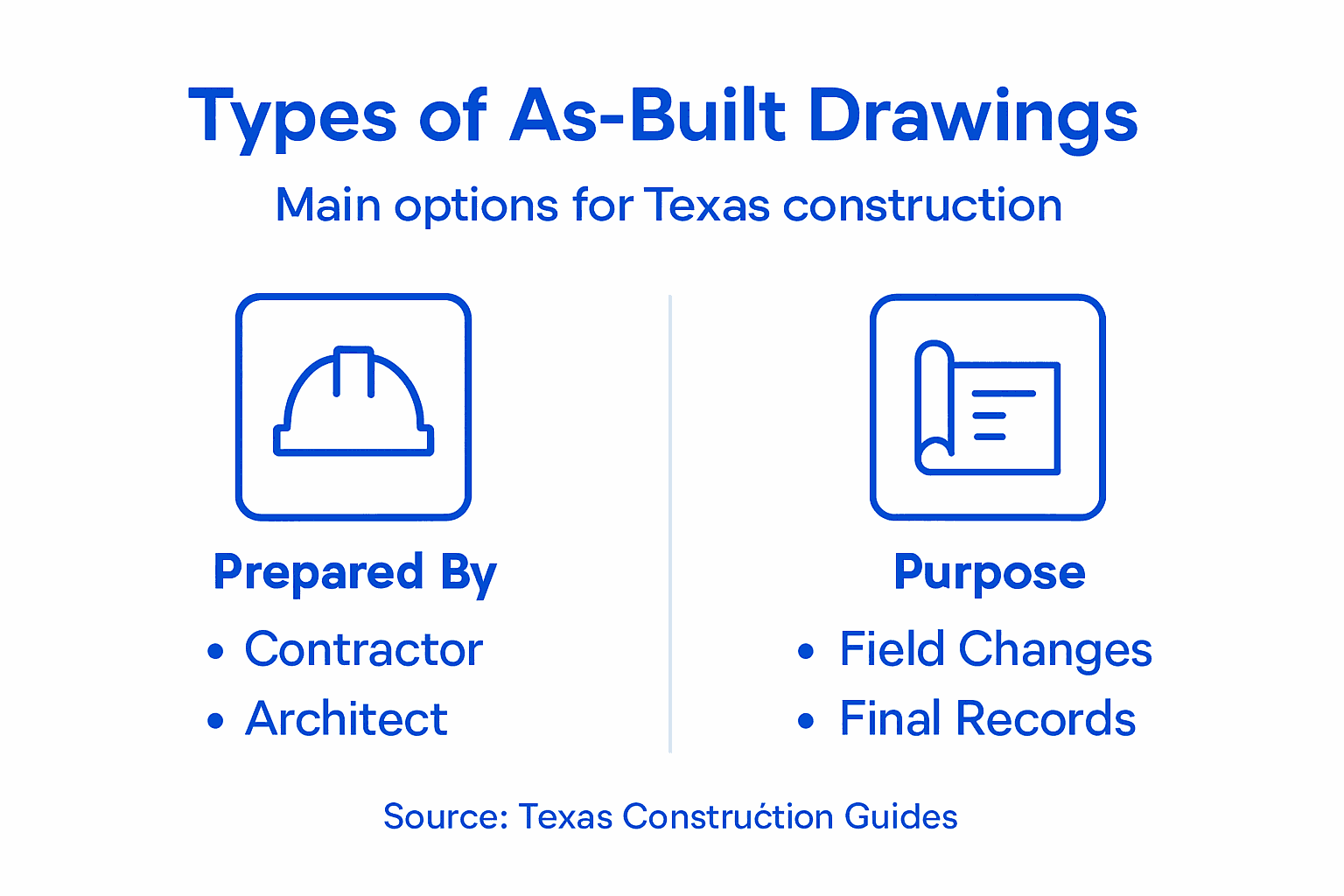
Not every construction project produces the same type of as-built documentation. The variety exists because different projects have different complexities and different regulatory requirements. Understanding which type you’re dealing with matters significantly for Texas homeowners and contractors. The basic division comes down to this: contractor-marked documents showing field changes represent your raw as-builts, while cleaned-up, professionally compiled versions become record drawings. Both serve essential purposes, but they’re created at different stages and by different people.
The first type is the contractor’s as-built. This is the working document. During construction in Houston, Dallas, Austin, or San Antonio, your general contractor or subcontractors mark changes directly onto the original blueprints as work progresses. A drainage line gets repositioned due to rock outcropping. An electrical conduit runs slightly different than planned because of framing adjustments. A foundation footing depth changes based on soil testing results. These aren’t failures or mistakes. These are normal field adaptations that happen on virtually every project. The contractor documents each change with marks, notes, dates, and initials. These marked-up drawings are rough and working-quality, but they capture the reality of what happened on site. They become the source material for everything that follows.
The second type is the record drawing, which is the polished, professional version. Architects or engineers compile contractor markups into clean, readable sets that show the completed project accurately. Record drawings remove the messiness of field notes and create a formal document suitable for filing with municipalities, providing to future owners, or using as a reference for renovations and maintenance. Think of contractor as-builts as rough notes, and record drawings as the published textbook. In Texas, many projects use record drawings as the official documentation because they’re legible, organized, and less prone to misinterpretation. They also include input from shop drawings prepared by subcontractors, adding another layer of documentation hierarchy.
Shop drawings deserve mention because they contribute significantly to the as-built process. Subcontractors, manufacturers, and specialty trades prepare shop drawings showing how they’ll construct their specific portions of the project. These might include detailed HVAC ductwork routing, electrical panel layouts, or plumbing riser diagrams. When these trades execute the work and encounter field conditions requiring changes, their modified shop drawings get incorporated into the final as-built documentation. This means your complete as-built record reflects input from your general contractor, all subcontractors, and design professionals, creating a comprehensive record of how everyone adapted to real-world conditions.
Small residential projects sometimes skip formal as-builts altogether. If a contractor completes work exactly as designed with no significant modifications, some builders don’t create separate as-built documents. However, this approach creates risk. Even minor changes like slightly repositioned outlets or adjusted window framing heights matter for future work. Texas licensed engineers recommend always requesting as-built documentation regardless of project size, because future contractors, inspectors, and owners will need accurate records of what exists beneath walls and in your foundation.
Pro tip: Ask your contractor which as-built type will be provided before signing the contract, and verify that record drawings will be completed and delivered before final payment, not months later.
Here’s a comparison of as-built drawing types and their primary functions in construction projects:
| Drawing Type | Who Prepares It | Main Purpose | Typical Use Cases |
|---|---|---|---|
| Contractor As-Builts | General Contractor | Document field changes during construction | Daily site record, working edits |
| Record Drawings | Architect/Engineer | Compile all changes into clean format | Final project archives, compliance |
| Shop Drawings | Subcontractors | Show detailed layout for specific systems | HVAC, electrical, plumbing updates |
Understanding Features and How They Work
As-built drawings work by capturing what actually exists in your completed structure, then translating that reality onto paper or digital files. The process sounds simple but involves precision that most homeowners never see. Detailed measurement capturing site conditions means contractors and engineers document everything with exacting care. They measure dimensions in standard units, record spatial relationships, note how utilities run, and capture the orientation of your structure relative to sun direction and surrounding properties. In Texas construction, this meticulous documentation prevents costly mistakes down the road when renovations or repairs become necessary.
The core features of as-built drawings fall into several categories. First is dimensional accuracy. 3D laser scanning technology now enables contractors to capture built environments digitally, producing detailed models showing true dimensions and spatial relationships far more precisely than hand measurements alone. Modern as-builts often include both traditional drawings and digital scans, giving you multiple ways to verify what exists. Second is completeness of information. These drawings show not just the structure itself but utilities, mechanical systems, electrical pathways, plumbing runs, HVAC ductwork, and grading around the foundation. Third is legal validity. As-built drawings function as legal documents, and they must accurately reflect what was constructed to serve their purpose in compliance verification, insurance claims, property sales, and future project planning.
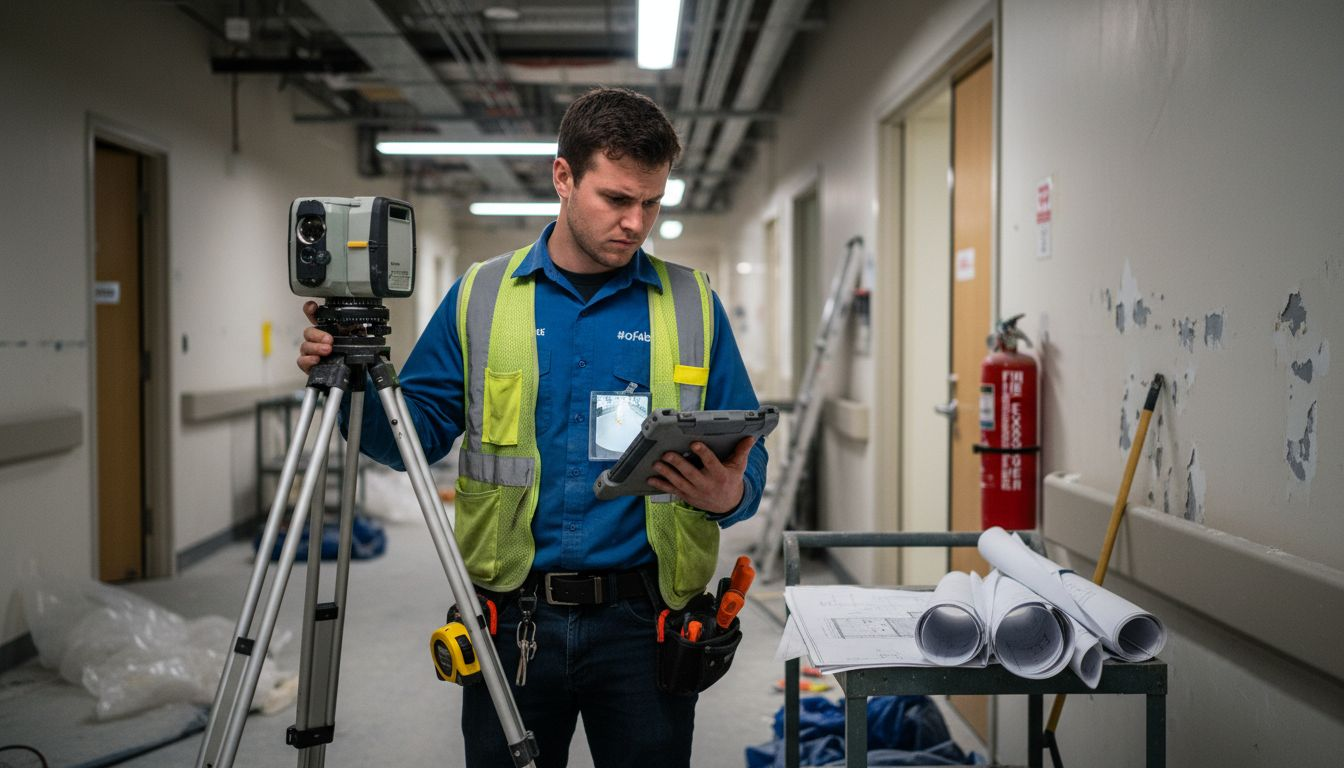
How they work in practice depends on your specific project type. For a residential addition in Austin, the contractor measures the new construction against the original structure, documents any adjustments made for existing conditions, and creates drawings showing how the addition integrates with your home. For a commercial renovation in Houston, technicians might use laser scanning to capture the entire space, then architects overlay those scans with updated plans showing renovated areas. For foundation work or drainage corrections in Dallas, engineers document existing conditions, the work performed, and the final result, creating a permanent record of what changed beneath your property. The method adapts to project complexity, but the principle remains constant: document reality with precision.
The documentation process typically involves multiple sets of drawings for complex projects. Your contractor starts with marked-up field copies during construction. Upon completion, they compile these into organized sets showing overall conditions. For projects involving structural changes, utility relocations, or significant modifications, multiple follow-ups ensure accuracy. Measurements get verified, systems get tested and documented, and site conditions get photographed. This layered approach catches errors before final documentation gets filed.
What makes as-built drawings valuable isn’t just their accuracy at the time of creation. They serve your project for decades. When you renovate your kitchen in San Antonio five years later, contractors reference the as-builts to find electrical circuits and plumbing lines without breaking through walls. When you file an insurance claim for storm damage in Houston, inspectors use as-builts to verify what should exist versus what was destroyed. When you sell your commercial property in Dallas, buyers and their engineers use as-builts to understand building systems. When foundation movement occurs and you need a structural assessment, engineers use as-builts as the baseline for comparison. These drawings become the permanent reference document for your entire structure.
Pro tip: Request that your contractor provide as-built drawings in both traditional PDF format and digital laser scan files if available, storing copies in multiple locations including cloud backup to ensure you always have access to these critical documents.
Compliance with Texas Building Codes and Laws
As-built drawings aren’t just administrative paperwork. They’re your proof of compliance with Texas building codes and the legal foundation for your entire construction project. When the Texas Department of Licensing and Regulation inspects your work, when municipalities review permits, or when disputes arise later, as-built drawings demonstrate that your project meets adopted standards. Texas Industrialized Housing and Buildings law requires constructions comply with adopted building codes and standards, ensuring safety and code conformity throughout the state. This applies to residential homes in Houston, commercial buildings in Dallas, and every construction type across Austin, San Antonio, and beyond. The as-builts you create during construction become the documentary evidence that your work follows these requirements.
Building code compliance in Texas works through a documentation chain. Contractors begin by following the original plans, which reflect code requirements. As work progresses and field conditions force adjustments, contractors document these changes on as-built drawings. Inspectors verify that modifications still comply with code intent and safety standards. Upon project completion, as-built sets must reflect reality, be properly labeled, and delivered within a timeframe after certificate issuance. They must meet formats ensuring clarity and accuracy and are subject to review before contract closure. This review process catches problems before your project gets final approval. If your contractor tries to skip as-built documentation or provides vague, incomplete drawings, you’re accepting significant legal and safety risk.
What compliance really means in practical terms depends on your project type and location. For residential additions in Texas, code compliance means your new structure integrates safely with existing systems. Electrical circuits must handle their loads. HVAC modifications must maintain proper ventilation. Structural connections must transfer loads safely. As-builts document how your contractor achieved this compliance when field conditions differed from plans. For commercial renovations, code compliance includes accessibility requirements, fire safety provisions, and operational standards. As-builts show that all these factors were addressed in the completed work. For foundation repairs or drainage corrections, compliance means the work addresses the original problem and meets Texas standards for soil bearing capacity, water management, and structural integrity.
The legal importance of as-builts for compliance purposes can’t be overstated. If your home develops foundation problems years after construction and you discover the contractor deviated from plans without documenting the changes, you lose your ability to prove whether the deviation caused the problem or whether the work met code at the time of construction. If you need to renovate and encounter unexpected conditions, as-builts help you understand what actually exists versus what was planned. If you file an insurance claim for damage and the insurer questions whether your property was built to code, your as-builts provide the evidence. If you sell your property and the buyer’s inspector finds discrepancies, your documented as-builts prove what work was done and what modifications were made. Texas licensed engineers use as-builts constantly when investigating structural problems, foundation failures, or water damage because they need to know exactly what was constructed.
Don’t assume that meeting code is automatic or obvious. Code violations happen regularly on Texas construction projects. Contractors might cut corners on details they don’t think matter. Subcontractors might not coordinate their work properly. Site conditions might force improvisations that weren’t reviewed for code compliance. Without as-builts documenting what was actually built and how it meets code requirements, you have no proof that your project complies. With as-builts, you have documentation that protects your investment, supports your insurance coverage, and provides the record needed for future work on your property.
Pro tip: Before making final payment to your contractor, hire a Texas licensed engineer to review the as-builts against the completed work to verify code compliance and ensure all modifications were properly documented.
Ownership, Responsibilities, and Documentation Risks
When it comes to as-built drawings, responsibility doesn’t rest with just one person. It flows through the entire project team, and understanding who owns what creates clarity when problems arise. Contractors are responsible for preparing and maintaining as-built documents during the construction process, ensuring accurate, high-quality records of modifications. This responsibility begins on day one of construction and continues through project completion. Architects and engineers then review and incorporate these contractor documents into final record drawings after substantial completion. The homeowner or property owner sits at the center of this chain, relying on everyone upstream to deliver accurate documentation. In Texas, when disputes arise about what was constructed or how work was performed, these responsibility lines determine who bears the financial and legal consequences.
For residential projects in Houston, Austin, Dallas, or San Antonio, your contractor carries primary responsibility for creating as-builts. They’re on site every day seeing what actually gets built. They know which changes were made, why they were necessary, and how they affect the final product. Your contractor must maintain detailed records throughout construction, not scramble to reconstruct them from memory at the end. Subcontractors share this responsibility for their portions of the work. Your HVAC contractor documents how ductwork was actually routed. Your electrician marks where circuits were repositioned. Your plumber records where water lines actually run. When final as-builts get compiled, they represent input from all these trades. If any subcontractor fails to provide accurate information, the entire as-built document becomes unreliable.
The documentation risks are substantial when this chain breaks down. Contractual agreements typically condition final payment on acceptable as-built documentation delivery, meaning your contractor can’t demand full payment until as-builts are complete and approved. If your contractor provides incomplete, inaccurate, or delayed as-builts, you can legally withhold payment. More importantly, inadequate documentation poses risks including payment delays, legal issues, and operational inefficiencies. When you discover foundation problems five years after construction and need to understand what was built, incomplete as-builts mean you can’t determine whether the problem existed from the start or developed due to defective workmanship. When you file an insurance claim and the carrier questions whether your property was built to code, missing as-builts mean you have no proof. When you hire a Texas licensed engineer to investigate structural problems, they’ll be hampered by poor documentation.
The risks extend beyond the immediate project. Inadequate as-builts create problems for future owners, contractors, and inspectors. If you sell your home or commercial property in Texas, buyers conduct inspections and often hire engineers to evaluate the structure. Without clear as-builts showing what was built and what modifications were made, future inspectors must spend time investigating undocumented conditions, increasing inspection costs and delaying closing. Future renovations become more expensive when contractors can’t reference as-builts to locate utilities and understand existing systems. Maintenance becomes guesswork instead of following documented records. If foundation movement occurs and you need structural assessment, engineers need as-builts as the baseline for comparison.
Protecting yourself means establishing clear contractual language before work begins. Specify that as-built drawings will be delivered before final payment. Require that they meet specific standards for accuracy, completeness, and format. Build in time for review and approval. When reviewing submitted as-builts, look for dated and initialed marks showing who documented each change and when. Ask your contractor to explain significant deviations from original plans. If something doesn’t make sense, request clarification in writing before accepting the drawings. Consider requiring third-party verification of critical systems like electrical circuits, plumbing, and structural modifications. Don’t accept vague statements like “followed original plans” when you know field conditions forced adjustments.
Pro tip: Add specific as-built drawing requirements to your contract before construction begins, including deadline for submission, approval process, and what happens if documentation is incomplete, stating that final payment depends on acceptable as-builts being delivered on schedule.
This table summarizes potential documentation risks and how they impact project outcomes:
| Risk Type | What Can Go Wrong | Long-Term Impact | Prevention Method |
|---|---|---|---|
| Incomplete As-Builts | Missing modifications or unclear notes | Legal disputes, costly repairs | Regular reviews, clear standards |
| Untimely Delivery | Delayed submission of documents | Payment delays, compliance issues | Contract deadlines, progress tracking |
| Inconsistent Format | Mixed styles or illegible marks | Inspection confusion, errors | Standardized marking practices |
Common Mistakes and Costly Omissions
As-built drawings fail for predictable reasons. Most mistakes stem from a lack of attention during construction combined with confusion about what documentation actually means. The most common error is confusing as-builts with record drawings. Contractors sometimes submit marked-up originals thinking that’s sufficient, without understanding that incomplete or untimely updates and failure to document changes caused by site conditions or requests for information create serious gaps. A contractor in Houston might mark a few changes on the blueprints, then claim that’s their as-built documentation. The document is rough, hard to read, shows only obvious changes, and lacks the professional organization that makes as-builts actually useful for future reference. Years later when you need to renovate or troubleshoot a problem, you discover the as-builts don’t show half the modifications that were actually made.
Another critical mistake is inadequate documentation of value engineering changes. When your contractor saves money by using different materials, routing utilities differently, or modifying construction methods to adapt to site conditions, those changes must get documented. Too often, contractors view these as “minor adjustments” not worth recording. But these adjustments matter. An electrical line routed through a different wall cavity changes where future work can occur. A plumbing modification affects maintenance access. A structural adjustment affects load paths. As-built drawings are often neglected during construction due to focus on other activities and perceived lack of glamour, meaning contractors prioritize visible work and push documentation to the end. By then, details get forgotten or misremembered.
Inconsistent documentation standards create another class of problems. One subcontractor marks changes in red ink. Another uses pencil. A third uses sticky notes. When everything gets compiled into final as-builts, some changes are clear while others are nearly illegible. Some modifications are dated and initialed. Others contain no identification of who made the mark or when. This inconsistency makes it difficult to verify accuracy. A Texas licensed engineer reviewing as-builts for a foundation investigation can’t confidently determine which marks represent actual field conditions versus someone’s speculation about what might have changed. Mistakes in interpretation lead to incorrect diagnoses and expensive, unnecessary repairs.
Omissions in contractor markups represent perhaps the most costly mistake. Your HVAC contractor might forget to mark where an additional return duct was added. Your electrician might not document an outlet repositioned due to framing changes. Your plumber might skip marking a water line that runs differently than planned. These omissions accumulate. When final as-builts get compiled, they contain gaps. Future contractors don’t know these systems exist or run where they actually do. During renovation work in Austin or Dallas, crews accidentally cut into unmarked lines or damage systems they didn’t know about. Projects suffer delays. Costs skyrocket. Lawsuits result.
Missing documentation of Request for Information responses creates legal exposure. When your engineer issues an RFI asking how something will be built, the contractor’s response becomes part of the as-built record. If the contractor resolves the RFI one way but builds it differently, that deviation must be documented with a new RFI or change order. When this doesn’t happen, no one can later determine why the work differs from the approved response. Disputes arise about whether the contractor fulfilled their obligations.
Protecting yourself means establishing rigorous documentation practices from day one. Require your contractor to maintain a dedicated as-built log during construction, not trying to recreate everything at the end. Specify that all changes require dated, initialed marks within 24 hours of completion. Schedule regular review meetings where you examine as-builts and question unclear modifications. Require standardized marking practices. Don’t allow vague statements. If an as-built shows a repositioned line, require notation of why it was moved and by whose approval. Before accepting final as-builts, have a Texas licensed engineer review them for completeness and accuracy. Better to catch problems before final payment than discover gaps years later.
Pro tip: During monthly site visits, review as-built documentation with your contractor and photograph any marked-up areas to create a visual record that supplements the drawings and prevents future disputes about what changes were actually made.
Secure Your Texas Construction Project with Accurate As-Built Documentation
Understanding the critical role that as-built drawings play in Texas construction means recognizing the risks of incomplete or inaccurate documentation. If you want to protect your investment and ensure compliance with Texas building codes, you need reliable engineering support that specializes in residential and commercial projects. Common challenges like unexpected field changes, foundation issues, and utility relocations require professional oversight to create precise, legally valid as-built records. Without this, costly disputes and renovation delays can quickly arise.

Don’t leave your project to chance. Explore expert solutions in engineering and inspections available at Engineering and Inspection Archives – Florida Licensed Engineers and get comprehensive support tailored for Texas construction demands. Visit Texas Licensed Engineers today for services including structural inspections, foundation assessments, forensic investigations, and detailed construction plans. Act now to secure your final payment, validate your as-built drawings, and protect your property from future surprises.
Frequently Asked Questions
What are as-built drawings?
As-built drawings are documents that record all the actual changes made during a construction project, reflecting how the completed structure actually exists rather than the original design intent.
Why are as-built drawings important in construction?
As-built drawings serve as a legal record of what was constructed, ensuring compliance with building codes and providing valuable information for future renovations or repairs.
What are the different types of as-built drawings?
There are generally two types of as-built drawings: contractor as-builts, which are rough and document field changes, and record drawings, which are polished versions compiled by architects or engineers.
How can I ensure that my contractor provides accurate as-built drawings?
You can request that your contractor maintain detailed records throughout the project, set clear deadlines for documentation delivery, and verify that they meet specific standards for accuracy and completeness before making final payment.
Recommended
- The Function As-Built Drawings Guide | Expert Engineers
- The Function As-Built Drawings Guide | Expert Engineers
- 8 Key Steps for a Texas Residential Construction Checklist – Texas Licensed Engineers | Residential & Commercial
- Structural Engineering Guide 2025 for Texas Projects – Texas Licensed Engineers | Residential & Commercial
