
Commercial vs Residential Engineering: Key Differences in Texas
Most American property owners in Houston, Austin, and Dallas are surprised to discover that over 80 percent of major Texas projects rely on specialized engineering services. The right choice between commercial or residential engineering can make a difference in safety, budget, and compliance. Understanding these distinctions helps Texas homeowners and business owners confidently navigate construction and renovation decisions while avoiding costly mistakes.
Table of Contents
- Defining Commercial and Residential Engineering
- Core Differences in Project Scope and Design
- Texas Codes, Permitting, and Safety Standards
- Unique Challenges in Residential Versus Commercial Work
- Cost, Liability, and Risk Factors Compared
Key Takeaways
| Point | Details |
|---|---|
| Distinction in Engineering Domains | Commercial engineering focuses on large-scale projects with complex systems, while residential engineering emphasizes personalized, simpler designs for individual homes. |
| Regulatory Frameworks | Commercial projects require extensive permitting and adherence to advanced codes, whereas residential projects follow more straightforward regulations and approvals. |
| Risk and Liability Differences | Commercial engineering involves higher financial and legal exposure, whereas residential projects have more predictable liabilities and consumer protections. |
| Consultation Importance | Always seek guidance from licensed Texas engineers who specialize in either commercial or residential projects to ensure compliance and optimal design outcomes. |
Defining Commercial and Residential Engineering
Engineering in Texas involves two primary domains: commercial and residential engineering. Each specialty serves distinct purposes and addresses unique project requirements. Commercial engineering focuses on designing structures for business, public, and institutional environments, encompassing complex facilities like offices, hospitals, schools, and retail spaces. These projects demand intricate system designs and sophisticated planning to support professional workplace and institutional needs.
Residential engineering, by contrast, centers on creating safe, functional living spaces for individuals and families. This specialty targets single-family homes, apartments, duplexes, and other housing structures. Unlike commercial projects, residential engineering typically involves simpler design considerations and smaller-scale systems. Commercial engineering requires more complex mechanical, electrical, and plumbing designs compared to residential projects, reflecting the different operational requirements between workplace and home environments.
The key differentiators between commercial and residential engineering extend beyond mere building type. They involve distinct regulatory frameworks, system complexity, safety standards, and engineering approaches. Commercial projects often require more extensive permitting, stricter code compliance, and advanced technological integration. Residential engineering prioritizes personal comfort, energy efficiency, and adaptability to individual homeowner needs.
Pro Engineering Tip: Always consult a licensed Texas engineer who specializes in your specific project type, whether commercial or residential, to ensure compliance with local building codes and optimal design performance.
Here is a comparative overview of key factors in commercial vs. residential engineering in Texas:
| Factor | Commercial Engineering | Residential Engineering |
|---|---|---|
| Typical Projects | Offices, hospitals, schools | Single-family homes, apartments |
| Design Complexity | High (integrated MEP systems) | Moderate (simpler systems) |
| Permitting Process | Multi-stage, rigorous reviews | Standard, simpler approvals |
| Regulatory Codes | 2021 IBC, advanced tech needs | 2021 IRC, homeowner-focused |
| Safety Standards | High public safety, risk analysis | Personal safety, comfort-oriented |
| Customization | Institutional/functional priorities | Highly personalized design |
| Risk & Liability | Greater financial/legal exposure | More predictable, homeowner-focused |
| Stakeholder Involvement | Multiple teams, contractors | Fewer stakeholders, direct clients |
Core Differences in Project Scope and Design
Residential and commercial engineering projects diverge significantly in their fundamental design approaches and project scopes, reflecting the unique demands of each sector. Residential engineering primarily focuses on creating comfortable, personalized living spaces that prioritize individual needs, energy efficiency, and aesthetic flexibility. These projects typically involve single-family homes, apartments, and other residential structures with simpler system requirements and more flexible design parameters.
Commercial engineering, in contrast, demands far more complex design considerations. These projects require intricate planning for mechanical, electrical, and plumbing systems that can support high-volume usage, multiple occupancy zones, and sophisticated operational needs. Commercial structures necessitate more advanced mechanical, electrical, and plumbing systems with significantly higher capacity and zoning requirements, reflecting the intensive operational demands of workplaces, institutions, and public spaces.
The project scope differences extend beyond system complexity to critical areas like structural integrity, safety standards, and regulatory compliance. Commercial projects must navigate more stringent building codes, undergo more extensive permitting processes, and incorporate advanced technological integrations. Residential projects, while still subject to building regulations, typically involve more straightforward structural considerations focused on individual living comfort and personal space optimization.
Pro Engineering Insight: When planning any construction project in Texas, carefully assess the specific engineering requirements of your project type, as residential and commercial designs demand distinctly different technical approaches and professional expertise.
Texas Codes, Permitting, and Safety Standards
Texas building regulations establish rigorous standards that differentiate between commercial and residential engineering projects, creating a complex framework of compliance requirements. As of July 2024, the state mandates specific code adoptions for different project types, including the 2021 International Building Code (IBC) for commercial structures and the 2021 International Residential Code (IRC) for residential developments. These comprehensive standards ensure safety, structural integrity, and consistent quality across diverse construction environments.
The permitting process in Texas represents a critical distinction between commercial and residential engineering projects. Commercial developments typically require more extensive documentation, multiple-stage reviews, and more intricate approval processes. Local jurisdictions like San Antonio implement specific code amendments that modify standard requirements for different building types, creating nuanced regulatory landscapes that engineers must navigate carefully. These variations can impact everything from fire safety systems and mechanical installations to electrical and plumbing configurations.
Safety standards in Texas engineering projects extend beyond basic building codes to encompass detailed requirements for structural design, occupancy load, emergency systems, and environmental considerations. Commercial projects face more stringent regulations due to their potential public impact, requiring advanced risk assessment, more comprehensive safety infrastructure, and more detailed engineering documentation. Residential projects, while still subject to rigorous standards, typically involve more straightforward safety compliance protocols focused on individual living environments.
Pro Engineering Tip: Always consult the most recent Texas Department of Licensing and Regulation guidelines before initiating any engineering project, as building codes and safety standards are frequently updated and can significantly impact design and permitting requirements.
The following table summarizes how Texas codes and approval processes differ by project type:
| Aspect | Commercial Projects | Residential Projects |
|---|---|---|
| Building Code Used | 2021 International Building Code | 2021 International Residential Code |
| Documentation Required | Detailed plans, multi-team inputs | Simpler plans, often sole engineer |
| Local Code Amendments | Frequent, impact approvals | Few, mainly standard codes |
| Safety Documentation | Extensive, multi-system focus | Focused on living conditions |
| Permit Review Timeline | Longer, more steps involved | Shorter, direct review |
| Inspections | Multiple phases, technical detail | Fewer, focus on safety basics |
Unique Challenges in Residential versus Commercial Work
Texas construction law introduces distinct legal and contractual challenges that significantly differentiate residential and commercial engineering projects, creating unique operational landscapes for engineers. Residential projects typically involve simpler contract structures, more straightforward consumer protections, and more predictable payment schedules. These projects prioritize individual homeowner needs, requiring engineers to balance technical precision with personal customization and comfort considerations.
Commercial engineering projects present substantially more complex challenges, particularly in system integration, stakeholder coordination, and regulatory compliance. Large-scale commercial systems demand extensive coordination between multiple professional teams, intricate design considerations, and advanced technological implementations, creating a significantly more demanding professional environment. Engineers must navigate complex interactions between architectural, mechanical, electrical, and structural design elements while maintaining strict adherence to commercial building standards.
The financial and legal frameworks further underscore the differences between residential and commercial engineering work. Commercial projects typically involve more sophisticated contract structures, higher documentation requirements, stricter deadlines, and more complex payment schedules. Residential engineering, by contrast, focuses more on individual client satisfaction, personalized design solutions, and meeting specific homeowner expectations while maintaining cost-effectiveness and structural integrity.
Pro Engineering Insight: Always conduct a comprehensive preliminary assessment of project-specific requirements, as the challenges between residential and commercial engineering can dramatically impact design strategies, budget allocations, and overall project success.
Cost, Liability, and Risk Factors Compared
Texas construction projects demonstrate profound differences in cost, liability, and risk management between residential and commercial engineering work, creating distinctly unique financial landscapes for professionals. Residential projects typically feature simpler financial structures with more predictable payment schedules and lower initial risk investments. These projects prioritize consumer protection, with tighter regulations and more standardized financial expectations that help mitigate potential economic uncertainties for homeowners.
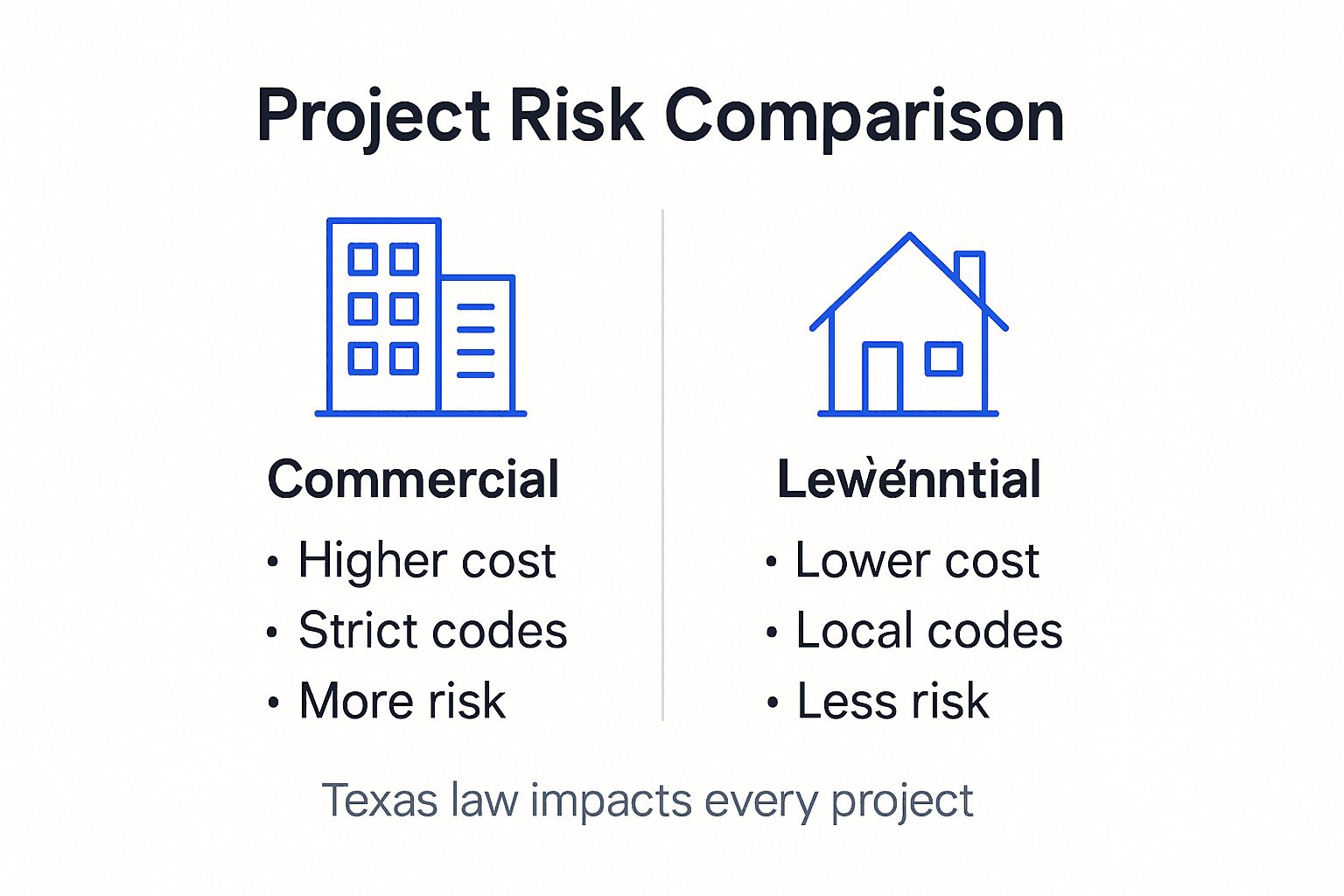
Large-scale infrastructure research reveals significant variations in risk allocation strategies across different project types, highlighting the complex financial dynamics of commercial engineering projects. Commercial work demands substantially higher up-front investigation, more sophisticated contingency planning, and broader risk management protocols. Engineers must navigate intricate financial landscapes that involve multiple stakeholders, more extensive documentation requirements, and significantly higher potential financial exposure compared to residential assignments.
Liability considerations further differentiate these project types, with commercial engineering introducing more complex legal and financial risk management strategies. Commercial projects typically involve higher insurance requirements, more extensive legal documentation, and greater potential for complex dispute resolution mechanisms. Residential engineering, while still demanding rigorous professional standards, generally offers more straightforward liability frameworks focused on individual homeowner protections and specific structural performance guarantees.
Pro Engineering Insight: Always conduct a comprehensive risk assessment and maintain robust professional liability insurance that specifically addresses the unique risk profile of your project type, as commercial and residential engineering demand distinctly different financial and legal protection strategies.
Expert Texas Licensed Engineering Services Tailored to Your Commercial or Residential Project
Navigating the critical differences in commercial and residential engineering in Texas can be challenging. You need a licensed professional who understands the unique building codes, permitting processes, and safety standards that apply to your specific project type. Whether you face complex mechanical and electrical system design for a commercial site or are prioritizing personalized comfort and energy efficiency for your home, partnering with experienced Texas licensed engineers will ensure your project meets all regulations and performs flawlessly.

Take advantage of specialized engineering support that covers structural inspections, foundation evaluations, construction plans, and forensic analyses tailored to your needs. Visit our comprehensive TLE Archives – Texas Licensed Engineers | Residential & Commercial to learn how our expertise bridges commercial and residential projects. Ready to move forward with confidence and compliance Contact us today at texaslicensedengineers.com and let our experts guide your project from planning to permitting with unmatched precision.
Frequently Asked Questions
What are the key differences between commercial and residential engineering?
Commercial engineering focuses on complex structures for business and public use, while residential engineering is concerned with simpler designs for homes and living spaces.
Why is the permitting process different for commercial and residential projects?
Commercial projects typically require more extensive documentation and multi-stage reviews due to stricter regulations and higher potential public impact compared to residential projects, which have a more straightforward approval process.
What factors influence the design complexity in commercial vs residential engineering?
Commercial engineering involves intricate planning for mechanical, electrical, and plumbing systems to support high-volume usage and multiple occupants, while residential engineering focuses on simpler systems tailored for individual homeowner needs.
How do safety standards differ between commercial and residential engineering projects?
Commercial engineering projects must adhere to higher safety standards due to their public accessibility, requiring detailed risk assessments and comprehensive safety documentation, whereas residential projects prioritize personal safety and comfort with less complex compliance protocols.
Recommended
- What Is Residential Engineering and Why Texas Homes Rely on It – Texas Licensed Engineers | Residential & Commercial
- What Is Civil Engineering and Its Impact on Texas Homes – Texas Licensed Engineers | Residential & Commercial
- Why Get Engineering Services in Texas Homes – Texas Licensed Engineers | Residential & Commercial
- Defining Civil Engineering Services in Texas Homes – Texas Licensed Engineers | Residential & Commercial
