
What is structural failure: Texas homeowner guide

You notice a crack in your wall and wonder if it’s harmless settling or something dangerous. Many Texas homeowners confuse normal settling with structural failure, risking safety and property value. Understanding structural failure is critical to protecting your home and family. This guide explains how to identify structural failure, its causes, the risks involved, and what you can do about it. You’ll learn to spot warning signs early, understand why Texas soil makes monitoring essential, and know when to call a professional.
Table of Contents
- Key takeaways
- Understanding what structural failure is and how it differs from normal settling
- Causes and mechanics of structural failure in Texas homes
- The risks of structural failure: safety, property value, and insurance implications in Texas
- Practical steps for Texas homeowners to prevent, detect, and address structural failure
- Protect your Texas home with expert structural inspections
- Frequently asked questions about structural failure
Key Takeaways
| Point | Details |
|---|---|
| Structural failure signs | Diagonal wide cracks and floors that slope more than one inch per ten feet indicate serious movement and require prompt evaluation. |
| Settling versus failure | Hairline vertical cracks and minor floor movement are usually normal settling and not signs of failure. |
| Clay soil impact | Clay soil in Texas expands when wet and shrinks when dry, creating continuous pressure that makes monitoring essential. |
| Early professional inspection | Early inspection by a licensed engineer and addressing drainage issues can prevent costly escalation. |
| Drainage and moisture control | Managing drainage and moisture balance reduces uneven foundation settlement and helps protect your home. |
Understanding what structural failure is and how it differs from normal settling
Structural failure sounds terrifying, but not every crack means disaster. Normal settling happens as your house adjusts to its foundation over time. You’ll see uniform hairline vertical cracks, typically thinner than a credit card. Minor floor slopes under 1 inch over 10 feet are also common. These signs rarely indicate serious problems.
Structural failure is different. Diagonal stair-step cracks wider than a credit card signal foundation movement. Floor slopes exceeding 1 inch per 10 feet indicate serious settlement. Doors and windows that stick or won’t close properly suggest shifting. Gaps between walls and ceilings or floors point to movement. These signs demand immediate attention.
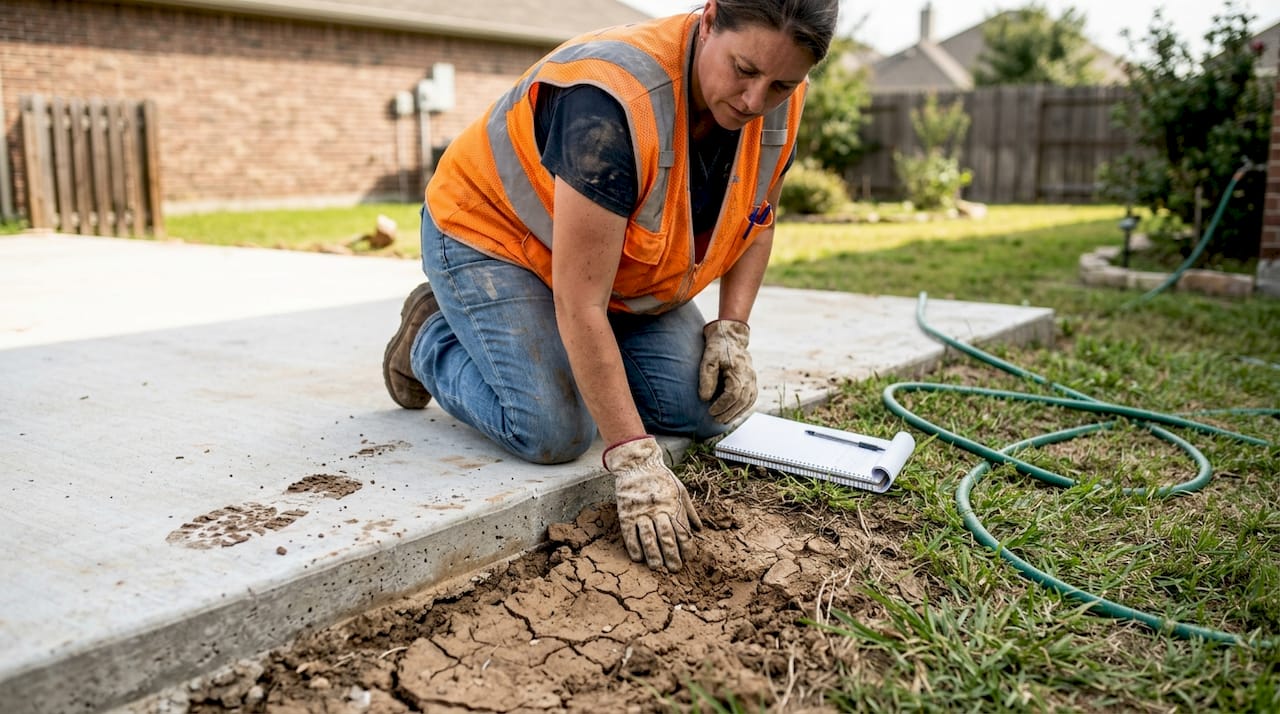
Texas clay soil makes monitoring critical. Clay expands when wet and shrinks when dry, creating constant pressure on foundations. During drought, soil pulls away from foundations. Heavy rains cause rapid expansion. This shrink-swell cycle stresses foundations year-round. Your house experiences more movement than homes in stable soil regions.
You can perform simple visual checks monthly. Walk around your home’s exterior looking for new cracks or widening existing ones. Check interior walls for diagonal cracks, especially near doors and windows. Place a level on floors in multiple rooms to detect slope changes. Note any doors or windows that suddenly stick. Document changes with photos and dates.
Professional evaluation becomes necessary when you spot warning signs. If cracks widen rapidly, floors slope noticeably, or multiple symptoms appear simultaneously, contact a licensed engineer. Foundation inspections identify problems before they escalate. Engineers use specialized tools to measure movement and assess severity. Early detection saves thousands in repair costs.
Here are key differences between normal settling and structural damage:
- Normal settling creates uniform hairline cracks, while structural damage produces wide irregular cracks
- Settling cracks remain stable over time, but structural cracks widen progressively
- Normal settling affects isolated areas, whereas structural failure shows multiple symptoms simultaneously
- Settling rarely impacts function, but structural damage causes doors and windows to malfunction
- Normal cracks are typically vertical, while structural cracks run diagonally or horizontally
Understanding these distinctions helps you respond appropriately. A foundation inspection checklist guides thorough evaluation. Don’t ignore warning signs hoping they’ll stabilize. Texas soil conditions make waiting risky.
Causes and mechanics of structural failure in Texas homes
Structural failures don’t happen randomly. They result from specific technical causes, many unique to Texas conditions. Understanding these causes helps you prevent problems before they start.
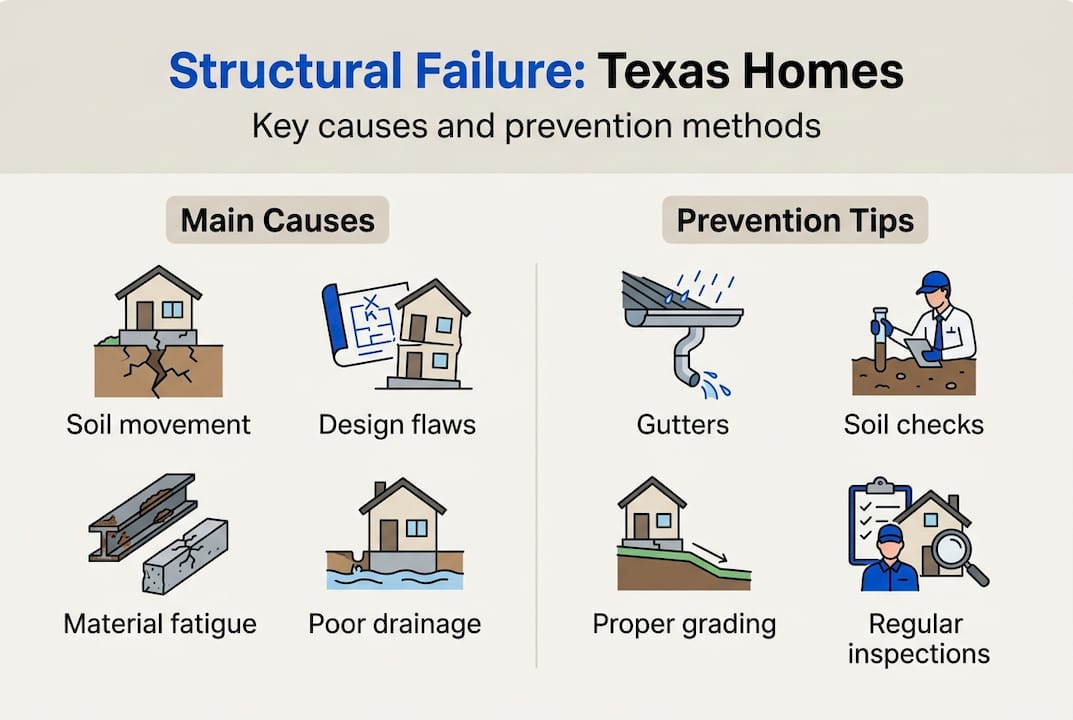
Soil movement tops the list. Clay soil’s shrink-swell behavior creates enormous pressure on foundations. When clay dries, it contracts and pulls away, removing support. When saturated, it expands and pushes against foundations. This constant cycling fatigues materials over years. Poor drainage accelerates the problem by creating uneven moisture distribution. Water pooling on one side causes differential settlement.
Foundation design flaws contribute significantly. Inadequate depth for soil conditions leads to instability. Insufficient reinforcement can’t handle stress from soil movement. Poor construction practices like improper curing or substandard materials create weak points. Foundation design must account for local soil properties.
Material fatigue develops over decades. Concrete develops microcracks from repeated stress cycles. Steel reinforcement corrodes when exposed to moisture. Wood components rot in humid conditions. These gradual degradations accumulate until failure occurs suddenly.
Progressive failure analysis reveals how small problems cascade. A minor crack allows moisture penetration. Moisture causes expansion and additional cracking. The cycle accelerates until major failure occurs. Engineers use finite element analysis to model these progressive failures and predict outcomes.
Buckling represents another failure mode. Flexural buckling occurs when columns or walls bend under load. Lateral-torsional buckling affects beams twisting under stress. Local buckling happens in thin-walled sections. Shear buckling affects web sections of beams. Shell buckling impacts curved structures. Each type requires specific engineering analysis.
Here are the top five technical causes of structural failure in Texas homes:
- Clay soil shrink-swell cycles creating differential foundation movement and uneven stress distribution
- Poor drainage systems allowing water accumulation that saturates soil unevenly and accelerates expansion
- Inadequate foundation depth or reinforcement failing to resist soil pressure and movement forces
- Material degradation from age, moisture exposure, and repeated stress cycles weakening structural capacity
- Construction defects including improper concrete mix, insufficient curing time, or substandard materials
Pro Tip: Controlling drainage and soil moisture costs far less than foundation repairs. Installing gutters, extending downspouts, and grading soil away from your foundation prevents most structural problems. Spending $2,000 on drainage improvements beats $15,000 foundation repairs.
Understanding these mechanics helps you recognize risk factors. Homes with poor drainage face higher failure risk. Properties on expansive clay need extra vigilance. Older homes require more frequent inspection as materials age. New construction should be monitored for design or construction flaws.
The risks of structural failure: safety, property value, and insurance implications in Texas
Ignoring structural failure creates serious consequences beyond repair costs. Safety hazards top the list. Compromised structures risk partial or complete collapse. Falling debris injures occupants. Unstable floors create trip hazards. Doors that won’t open trap people during emergencies. These aren’t theoretical risks. [Structural collapse](https://www.osha.gov/emergency-preparedness/guides/structural-collapse#:~:text=What is a collapsed structure) causes injuries and deaths annually.
Property value takes a major hit. Structural damage reduces home value by 15 to 25 percent depending on severity. Buyers demand steep discounts or walk away entirely. Appraisals come in low, killing financing. You lose equity built over years. Selling becomes difficult even at reduced prices. Disclosure laws require revealing known structural problems, limiting your options.
Insurance complications add financial stress. Many policies exclude damage from settling or soil movement. Insurers deny claims if they determine you neglected maintenance. Coverage disputes drag on for months. You might pay for repairs out of pocket while fighting for reimbursement. Future coverage becomes expensive or unavailable once insurers flag your property.
Here are consequences homeowners face when ignoring structural failure signs:
- Emergency repairs cost 3 to 5 times more than preventive maintenance as damage spreads rapidly
- Temporary relocation expenses add thousands while repairs make your home uninhabitable
- Legal liability if structural failure injures visitors or damages neighboring properties
- Difficulty obtaining homeowner’s insurance or facing premium increases after claims
- Forced sale at distressed prices when damage becomes too expensive to repair
- Emotional stress from living in an unsafe home and financial burden of unexpected costs
Timely repairs prevent catastrophic collapse and debris hazards that endanger lives. Addressing structural problems early protects your family’s safety and preserves your home’s value. Waiting turns manageable repairs into financial disasters.
The foundation repair workflow shows how early action reduces costs. Initial repairs might cost $5,000 to $8,000. Delayed repairs escalate to $20,000 or more as damage spreads. Emergency stabilization after partial collapse can exceed $50,000.
Insurance becomes particularly tricky in Texas. Standard policies cover sudden events like storms but exclude gradual deterioration. You need to prove damage resulted from a covered peril, not neglect. Documentation matters enormously. Photos showing crack progression, maintenance records, and inspection reports strengthen claims. Without documentation, insurers assume neglect and deny coverage.
A comprehensive Texas foundation inspections guide helps you understand what professionals evaluate. Engineers assess crack patterns, measure slopes, check for moisture problems, and determine causes. Their reports provide documentation for insurance claims and guide repair priorities.
Don’t gamble with structural integrity. The risks far outweigh inspection and repair costs. Protecting your family’s safety and financial investment requires prompt action when warning signs appear.
Practical steps for Texas homeowners to prevent, detect, and address structural failure
Prevention beats repair every time. You can take concrete steps to protect your home from structural failure. These actions work specifically for Texas conditions and soil challenges.
Here are preventive measures ranked by effectiveness:
- Install and maintain proper drainage systems including gutters, downspouts extended 10 feet from foundation, and grading that slopes away from your home
- Control soil moisture with soaker hoses during drought to prevent clay shrinkage and foundation settlement
- Schedule annual professional inspections to catch problems early when repairs cost less
- Monitor visible signs monthly by photographing cracks and measuring floor slopes to track changes
- Address plumbing leaks immediately as water intrusion accelerates soil expansion and foundation damage
- Maintain consistent soil moisture year-round rather than allowing extreme wet-dry cycles
- Trim trees and large shrubs near foundations as roots extract moisture causing uneven soil shrinkage
Comparing prevention strategies helps you prioritize investments:
| Strategy | Typical Cost | Effectiveness | Pros | Cons |
|---|---|---|---|---|
| Drainage control | $1,500-$3,000 | Very high | Prevents most problems, improves property value | Requires ongoing maintenance |
| Foundation piers | $8,000-$15,000 | High for existing damage | Stabilizes severe settlement | Expensive, doesn’t prevent future issues |
| Professional inspections | $300-$600 annually | High for early detection | Catches problems early, expert analysis | Requires follow-through on recommendations |
| Soil moisture control | $500-$1,200 setup | Moderate to high | Low ongoing cost, easy to maintain | Requires consistent attention |
| DIY monitoring | Minimal cost | Moderate | Free or cheap, builds awareness | Requires knowledge to interpret signs |
Pro Tip: Always get a licensed engineer’s evaluation before attempting repairs. DIY foundation fixes often worsen problems and void warranties. Engineers identify root causes, not just symptoms. A $500 inspection saves you from $10,000 mistakes.
Not all cracks are structural. Surface cracks in concrete or plaster result from curing, temperature changes, or minor settling. Structural cracks penetrate deeply, widen over time, and show displacement. Engineers distinguish between cosmetic and structural issues, preventing unnecessary repairs.
Choosing the right inspection type matters. A structural inspection checklist covers all critical areas. The structural inspection process involves visual assessment, measurements, and sometimes invasive testing. Different types of structural inspections address specific concerns like foundation movement, roof structure, or load-bearing walls.
Typical costs for common repairs help you budget. Minor crack repairs run $500 to $1,500. Drainage improvements cost $1,500 to $3,000. Foundation leveling ranges from $5,000 to $15,000 depending on severity. Pier installation averages $1,000 to $1,500 per pier, with most homes needing 8 to 12 piers. Emergency stabilization after significant failure exceeds $20,000.
Early action dramatically reduces expenses. Addressing drainage problems costs $2,000 but prevents $10,000 foundation repairs. Filling minor cracks costs $800 but stops water intrusion that causes $5,000 damage. Annual inspections costing $500 catch problems when repairs cost $2,000 instead of $15,000.
Document everything. Take monthly photos of any cracks from the same angle and distance. Measure crack widths with a crack gauge or credit card. Record dates when you notice changes. Keep receipts for all maintenance and repairs. This documentation proves you maintained your property, strengthening insurance claims and demonstrating care to future buyers.
Create a maintenance schedule. Inspect gutters and downspouts quarterly. Check soil moisture monthly during summer. Walk your property after heavy rains looking for drainage problems. Schedule professional inspections annually or after severe weather. Consistency catches problems before they become emergencies.
Know when to escalate. Small stable cracks don’t require immediate professional help. Rapidly widening cracks, multiple symptoms appearing together, or noticeable floor slopes demand expert evaluation. Trust your instincts. If something looks wrong, get a professional opinion. A $500 inspection provides peace of mind or catches serious problems early.
Protect your Texas home with expert structural inspections
You’ve learned to identify structural failure signs and understand the risks of ignoring them. Now take the crucial next step: professional evaluation. Texas Licensed Engineers specializes in structural and foundation inspections designed specifically for Texas soil conditions and climate challenges.
Our comprehensive structural inspection checklist ensures nothing gets overlooked. We evaluate foundation integrity, measure settlement, assess crack patterns, and identify moisture problems. Our detailed structural inspection process combines visual assessment with precise measurements and engineering analysis.

We offer various types of structural inspections tailored to your specific concerns. Whether you’re buying a home, noticed warning signs, or want preventive evaluation, we provide expert analysis and actionable recommendations. Early professional inspection saves thousands in repair costs and protects your family’s safety. Don’t wait until minor problems become major disasters.
Frequently asked questions about structural failure
What is a structural failure?
Structural failure occurs when a building component can no longer safely support its intended loads, resulting in collapse, excessive deformation, or loss of stability. In homes, this typically involves foundation settlement, wall cracking, or roof sagging that compromises safety and requires immediate repair.
How do I tell the difference between hairline cracks and structural cracks?
Hairline cracks are thin (less than 1/16 inch), uniform, and typically vertical, caused by normal settling or concrete curing. Structural cracks exceed 1/4 inch width, run diagonally or in stair-step patterns, show displacement or separation, and widen over time, indicating serious foundation or framing problems.
When should I hire a structural engineer in Texas?
Hire a structural engineer when you notice diagonal or widening cracks, floor slopes exceeding 1 inch over 10 feet, doors or windows that stick, or gaps between walls and ceilings. Also consult an engineer before buying a home with visible foundation issues or after severe weather events.
How long do structural failure repairs typically take in Texas?
Minor crack repairs take 1 to 3 days. Foundation leveling with piers requires 3 to 7 days depending on home size. Extensive structural repairs can take 2 to 4 weeks. Timeline depends on damage severity, weather conditions, and permit requirements in your municipality.
Will my insurance cover structural failure repairs in Texas?
Standard homeowner’s insurance typically excludes damage from settling, soil movement, or maintenance neglect. Coverage applies if structural failure results from a covered peril like storm damage or plumbing leaks. Document all maintenance and get professional inspections to strengthen claims and prove sudden damage versus gradual deterioration.
Recommended
- Structural Inspection in Texas – Protecting Property Value – Texas Licensed Engineers
- Tree Fall Structural Inspection Steps for Texas Homes – Texas Licensed Engineers
- How to Request Structural Inspection for Texas Homes – Texas Licensed Engineers
- How to Order Structural Inspection for Texas Homes – Texas Licensed Engineers
- Complete Shingle Replacement Guide for Homeowners – Liberty Roofworks


